☆ Find us again easily

Found a page you like? Save it for later.

🔎 To find us again

Address
thevibelab.net
Search
Vibe Lab Korean

Korean Numbers & Honorifics

Read prices, counts and times in Korean — and pick the right honorifics

What you’ll learn here

Korean has two sets of numbers: Sino-Korean 일·이·삼 and native Korean 하나·둘·셋. Prices use the first set, counting things uses the second, and telling the time uses both at once. Honorifics work in a similar way. For an elder you don’t just add a polite ending; you swap in a different word, such as 드시다 for 먹다 or 댁 for 집. This game covers numbers in three stages and honorifics in two. When you finish, the goal is to read a price tag or a clock out loud in Korean without stopping to think, and to choose the right words when speaking to grandparents or serving a customer.

Prices (stage 1)

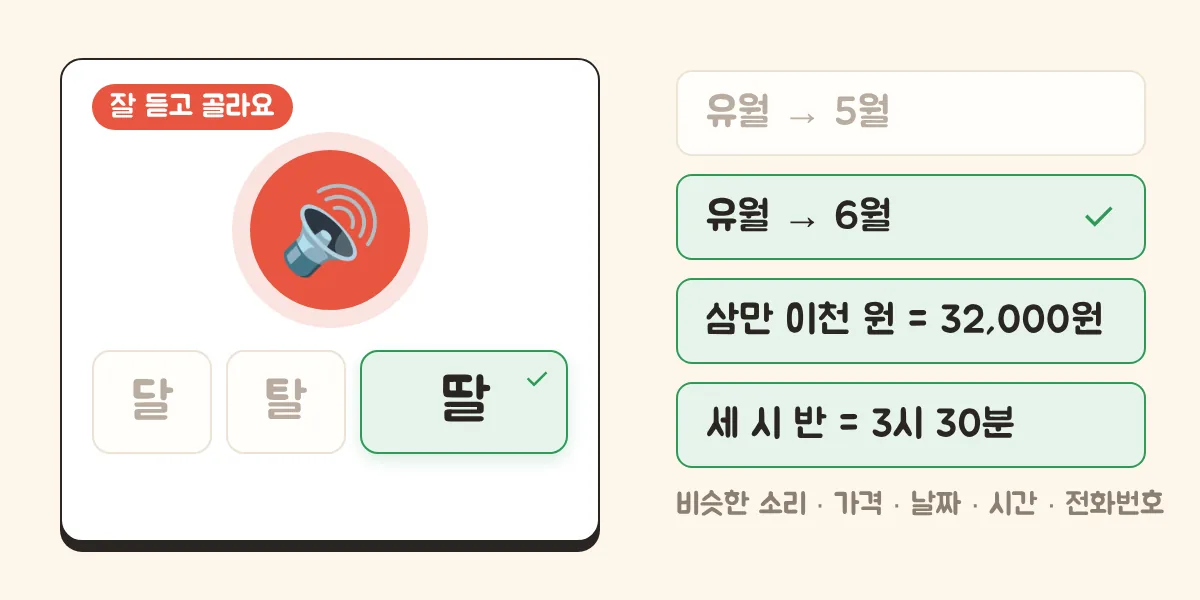
Price tags from 100 to 99,500 won, read with Sino-Korean numbers and grouped by 만 (10,000). 13,500 won is 만 삼천오백 원. Note that 10,000 is just 만, not 일만, and 1,000 is 천, not 일천.

Counting things and people (stage 2)

Count apples, students, cats, cups of coffee, books, cars and more, from 1 to 10. Native numbers shorten in front of a counter: 하나→한, 둘→두, 셋→세, 넷→네. You also have to pick the right counter: 명 for people, 마리 for animals, 잔 for cups, 권 for books, 대 for vehicles.

Telling the time (stage 3)

Hours use native numbers and minutes use Sino-Korean ones, so 3:20 is 세 시 이십 분. The wrong answers read the hour as 삼 시 or the minutes as 스물 분.

Honorific words (stage 4)

Word swaps for elders: 먹다→드시다, 자다→주무시다, 있다→계시다, 아프다→편찮으시다, 집→댁, 나이→연세, 이름→성함, 생일→생신. It also covers the humble verbs you use when doing something for an elder: 드리다 (give), 여쭙다 (ask) and 뵙다 (see).

Honorific sentences (stage 5)

Whole sentences, like turning 할머니가 밥을 먹어요 into 할머니께서 진지를 드세요, plus the way shop staff speak to customers, like 주문하시겠어요?. You practise using 께서 instead of 이/가 and 께 instead of 에게.
How to use

A price tag, a group of things or a clock (in stages 4–5, a plain word or sentence) appears in the middle. Pick the right Korean from the answers below and you hear it read aloud, with romanization and the rule behind it. The wrong answers are traps: the wrong number system (셋천오백 원), the wrong counter (사과 세 명), or the wrong hour reading (삼 시 이십 분).

Stage 1 is prices (일·이·삼; 10,000 won is just 만 원), Stage 2 is counting things and people (하나·둘·셋 with counters like 개·명·마리·잔·병·권·대·장, and the short forms 한·두·세·네), and Stage 3 is telling the time (hours in 한·두·세, minutes in 일·이·삼). Stages 1–3 are generated fresh every time, so you never run out of questions.

Stage 4 is honorific words for elders — 먹다 → 드시다, 자다 → 주무시다, 집 → 댁, 나이 → 연세. Stage 5 is whole sentences: family honorifics like 할머니께서 진지를 드세요 and how shop staff speak, like 주문하시겠어요?. A common mistake — honoring things, as in 커피 나오셨습니다 — shows up as a trap too.

Each stage has 10 questions. Every mistake costs a heart; lose all 3 and the stage fails, so you start it again. You earn one star (up to 3) for each heart left, and any star unlocks the next stage.

How to get more out of it

Say it before you look at the answers

When a price tag or clock appears, read it aloud first, then find your version among the choices. That is the skill you need at a real counter.

Work out what each trap changed

Wrong answers swap the number system (셋천오백 원), the counter (사과 세 명) or a digit. A miss costs a heart and you try the same question again, so first check which of these caught you.

Read the rule line

Once you pick the right answer, you hear it read aloud and see its romanization plus a one-line rule for the stage. On a miss, read that rule out loud once.

Count what’s around you

After stage 2, count things on your desk or in your fridge in Korean: 펜 세 개, 달걀 여섯 개. Reading the clock in Korean whenever you check the time helps stage 3 stick.

Learn 드시다 and 드리다 as a pair

드시다 is what an elder does when they eat; 드리다 is what you do when you give something to an elder. They look alike and the game uses one as a trap for the other.

Replay the number stages

Stages 1–3 make new questions every time. You can repeat them until you get 3 stars without ending up memorizing answers.

Who it’s for

  • Beginners who keep mixing up Korean’s two number systems
  • Travelers and residents who want to say prices, amounts and times in Korean
  • Anyone who will be talking with Korean in-laws or other elders
  • People working, or about to work, with customers in a Korean shop or restaurant

Sample questions

These are real question types from the game written out. Number questions are generated fresh every time, but the trap answers always follow the same rules.

  1. 👀 On screen: Price tag ₩13,500 (man samcheonobaek won)

    Choices: 만 셋천오백 원 · 만 삼천오백 원 · 만 오천삼백 원 · 만 사천오백 원

    ✅ Answer: 만 삼천오백 원 — Prices use Sino-Korean numbers all the way through; 셋천 mixes in a native number. 10,000 is 만 on its own, so 13,500 starts with 만, not 일만.

  2. 👀 On screen: 🍎 × 3 (sagwa se gae)

    Choices: 사과 삼 개 · 사과 셋 개 · 사과 세 개 · 사과 네 개

    ✅ Answer: 사과 세 개 — Counting uses native numbers, and 셋 shortens to 세 before a counter like 개. 삼 is the Sino-Korean number, and 셋 is the unshortened form.

  3. 👀 On screen: Clock 3:20 (se si isip bun)

    Choices: 삼 시 이십 분 · 세 시 스물 분 · 세 시 이십 분 · 네 시 이십 분

    ✅ Answer: 세 시 이십 분 — The hour is native (세) and the minutes are Sino-Korean (이십). One time mixes both systems, so read the hour and the minutes separately.

  4. 👀 On screen: 먹다 (to eat) (meokda)

    Choices: 주무시다 · 드리다 · 드시다 · 계시다

    ✅ Answer: 드시다 — When an elder eats, you say 드시다. 드리다 looks similar but means giving something to an elder, the opposite direction.

  5. 👀 On screen: (clerk to customer) 주문한 커피 나왔어요. (jumunhan keopi nawasseoyo.)

    Choices: 주문하신 커피 나오셨습니다. · 주문하신 커피 나왔습니다. · 주문한 커피 나오셨어요. · 주문하신 커피가 계십니다.

    ✅ Answer: 주문하신 커피 나왔습니다. — You honor the customer, not the coffee. 주문하신 takes -시- because the customer ordered, but 나왔습니다 doesn’t, because the coffee is what came out. 나오셨습니다 is common in shops but incorrect.

Test your Korean level ⏱ About 5 minutes · 20 questions ▶ Start the test

🔤 Hangul alphabet → 🔢 Korean numbers tool → 📚 Learn Korean with free games →

More apps & games

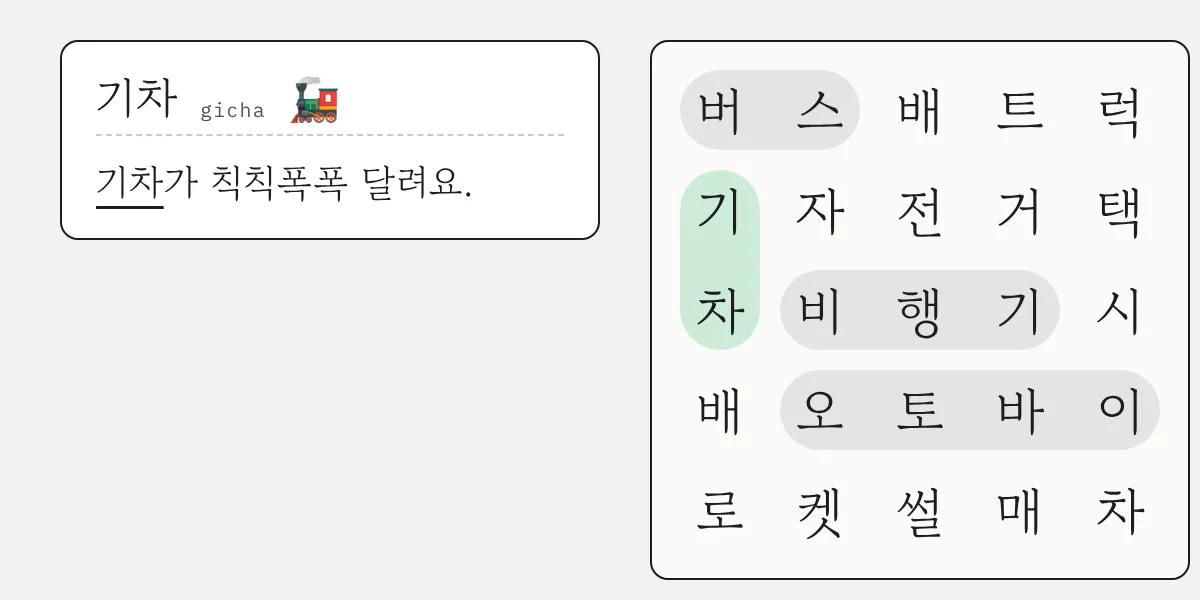
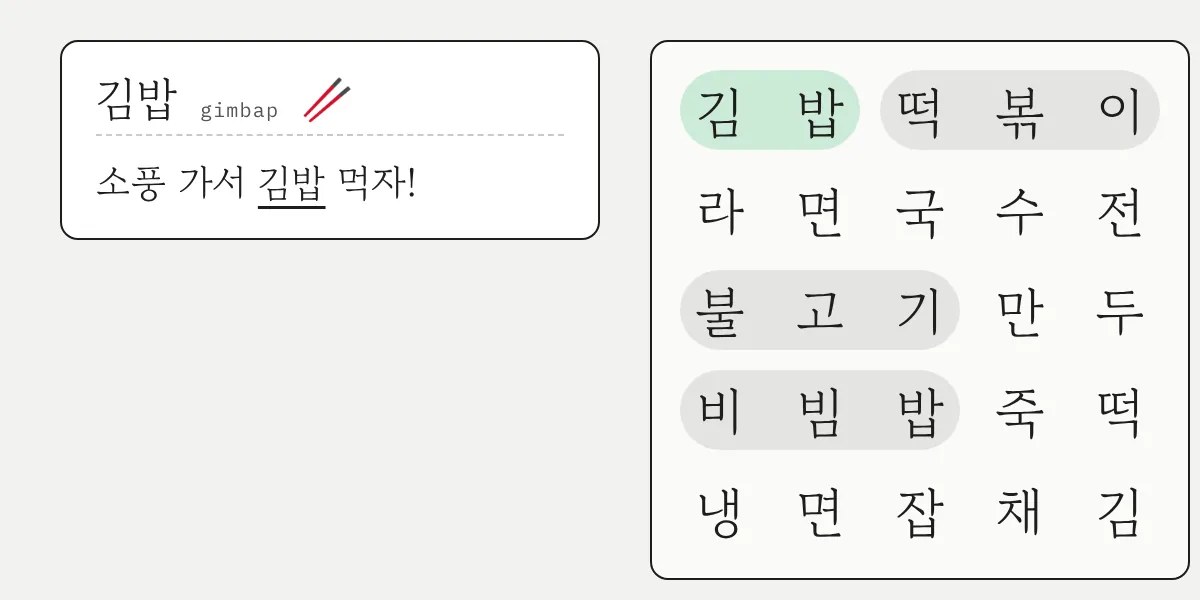
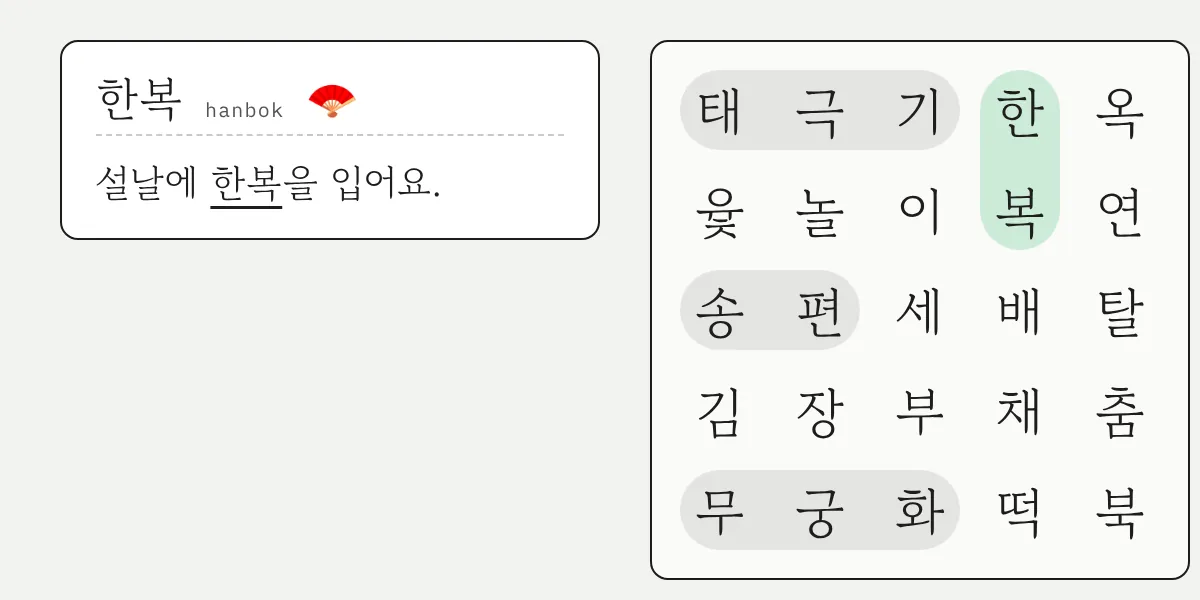
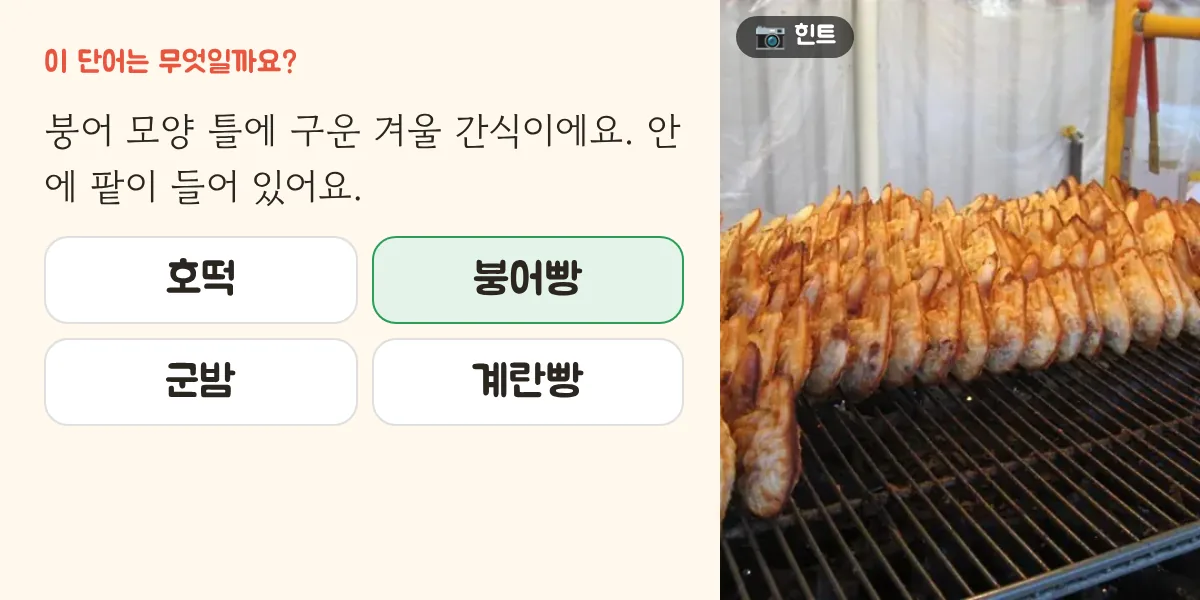
🔍 Korea Hidden Pictures (Learn Korean Words)GameKorea Hidden Pictures (Learn Korean Words) – Seoul Forest – Floor FountainKorea Hidden Pictures (Learn Korean Words) – Myeongdong StreetKorea Hidden Pictures (Learn Korean Words) – Korean BBQ RestaurantKorea Hidden Pictures (Learn Korean Words) – Seoul SubwayKorea Hidden Pictures (Learn Korean Words) – Factory FloorKorea Hidden Pictures (Learn Korean Words) – Gyeongbokgung PalaceKorea Hidden Pictures (Learn Korean Words) – Namsan & N Seoul TowerKorea Hidden Pictures (Learn Korean Words) – Seokchon Lake – Cherry Blossom PathKorea Hidden Pictures (Learn Korean Words) – Convenience StoreKorea Hidden Pictures (Learn Korean Words) – Farm GreenhouseKorea Hidden Pictures (Learn Korean Words) – Lotte World Tower – Christmas MarketKorea Hidden Pictures (Learn Korean Words) – Han River ParkEvery hidden object you find teaches you a Korean word🔍 Hidden objects📖 Korean words🔊 Hear it spoken👶 Kid-friendlyHangul Word SearchGameHangul Word Search – rainbowHangul Word Search – appleHangul Word Search – tigerHangul Word Search – trainHangul Word Search – gimbapHangul Word Search – hanbokFind Korean words hidden in a grid — each one is read aloud with a picture and its meaning🧩 Word search📖 700+ words⏱ Time limit👶 Kid-friendlyGuess the Korean WordGameGuess the Korean WordSee a real photo, read the clue, guess the Korean word✅ Word quiz📷 Real photos🔊 Hear it spoken⭐ 5 stagesKorean Sentence BlocksGameKorean Sentence BlocksBuild Korean sentences from word blocks and pick the right particles🧩 Sentence building🔤 Particle practice🔊 Hear it spoken⭐ 5 stages