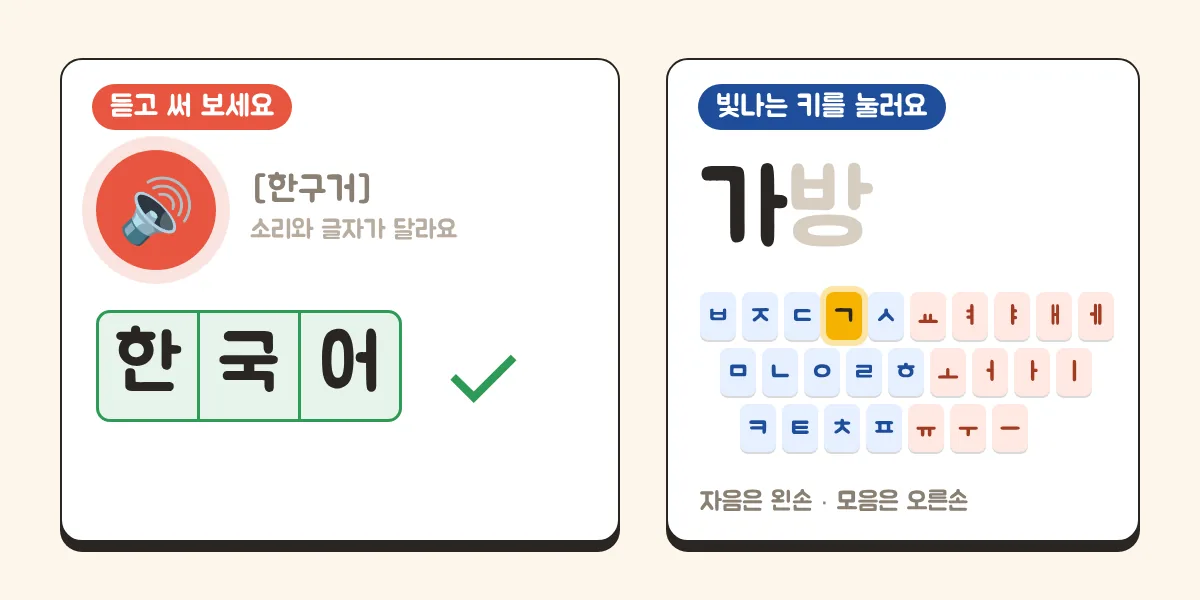
Korean alphabet (Hangul) chart
Hangul has 40 letters: 19 consonants (14 basic — ㄱㄴㄷㄹㅁㅂㅅㅇㅈㅊㅋㅌㅍㅎ — plus 5 double consonants ㄲㄸㅃㅆㅉ) and 21 vowels (10 basic — ㅏㅑㅓㅕㅗㅛㅜㅠㅡㅣ — plus 11 compound vowels). All 40 Hangul letters on one page. Tap any letter or syllable to hear it, see how letters stack into blocks, and meet an example word for each letter — then practise reading them in our free games.
Hangul in 1 minute
Hangul was created in 1443 under King Sejong and announced in 1446 so that everyone could read and write easily. It is an alphabet: each letter is one sound.
Letters are written in syllable blocks. A block always has a consonant and a vowel, and sometimes a final consonant underneath (batchim). Learn the 14 basic consonants and 10 basic vowels first — the rest are combinations of them.
How letters make a syllable block
Start consonant + vowel (+ final consonant). Vertical vowels like ㅏ go on the right; horizontal vowels like ㅗ and ㅡ go underneath.
Consonants (14 basic)
Tap a letter to hear its name. Many consonants sound different at the start of a syllable and as a final consonant.









💡 Three kinds of sounds: plain ㄱ ㄷ ㅂ ㅅ ㅈ, aspirated (with a puff of air) ㅋ ㅌ ㅍ ㅊ, and tense ㄲ ㄸ ㅃ ㅆ ㅉ. Hold a tissue in front of your mouth: it should move for 카 but barely for 까.
Double consonants (5)
Written twice, said tense and sharp — with no puff of air.


Vowels (10 basic)
A vowel on its own is written with a silent ㅇ: 아, 어, 오. Tap to hear.







💡 Tricky ones: ㅓ (eo) is an open "uh" as in "but", while ㅗ (o) has rounded lips. ㅡ (eu) is said with flat, unrounded lips.
Combined vowels (11)
Two vowels joined into one sound. In everyday speech ㅐ and ㅔ sound almost the same, and so do ㅙ, ㅚ and ㅞ.





Syllable chart (가나다)
14 consonants × 10 vowels = 140 syllables. Tap any syllable to hear it. Reading across a row is how Korean children practise.
| a | ya | eo | yeo | o | yo | u | yu | eu | i | |
|---|---|---|---|---|---|---|---|---|---|---|
| g | ||||||||||
| n | ||||||||||
| d | ||||||||||
| r | ||||||||||
| m | ||||||||||
| b | ||||||||||
| s | ||||||||||
| j | ||||||||||
| ch | ||||||||||
| k | ||||||||||
| t | ||||||||||
| p | ||||||||||
| h |
Final consonants (batchim): only 7 sounds
At the end of a syllable, many letters collapse into just seven sounds. That is why 옷 (clothes) is pronounced "ot".






Practise reading with games
- Hangul Word Search — Find words in the letter grid — the best first step after this chart.
- Korean vocabulary by theme — Read word lists by theme, from easy to harder.
- Korea Hidden Pictures (Learn Korean Words) — Learn words in real places in Korea, one hidden object at a time.
- Guess the Korean Word — Check what you can read with a quick quiz.
- Korean Dictation & Keyboard Typing — Learn the Korean keyboard, then hear words and write them in Hangul.
Frequently asked questions
How many letters are in the Korean alphabet?
40 in total: 14 basic consonants + 5 double consonants, and 10 basic vowels + 11 combined vowels. The 24 basic letters are enough to read most words.
How long does it take to learn Hangul?
Most people can read the letters slowly after a few days of short practice. Fluent reading comes from reading real words — that is what the games are for.
Why does ㅇ have no sound?
At the start of a syllable ㅇ is a silent placeholder, because every block needs a consonant (아 = just "a"). At the end of a syllable it sounds "ng", as in 강 (gang).
Is the audio a real person?
The 🔊 buttons use your device’s built-in Korean voice, so they work for every syllable. Sound quality depends on your device.