☆ Find us again easily

Found a page you like? Save it for later.

🔎 To find us again

Address
thevibelab.net
Search
Vibe Lab Korean

🔍 Korea Hidden Pictures (Learn Korean Words)

Every hidden object you find teaches you a Korean word

How to use

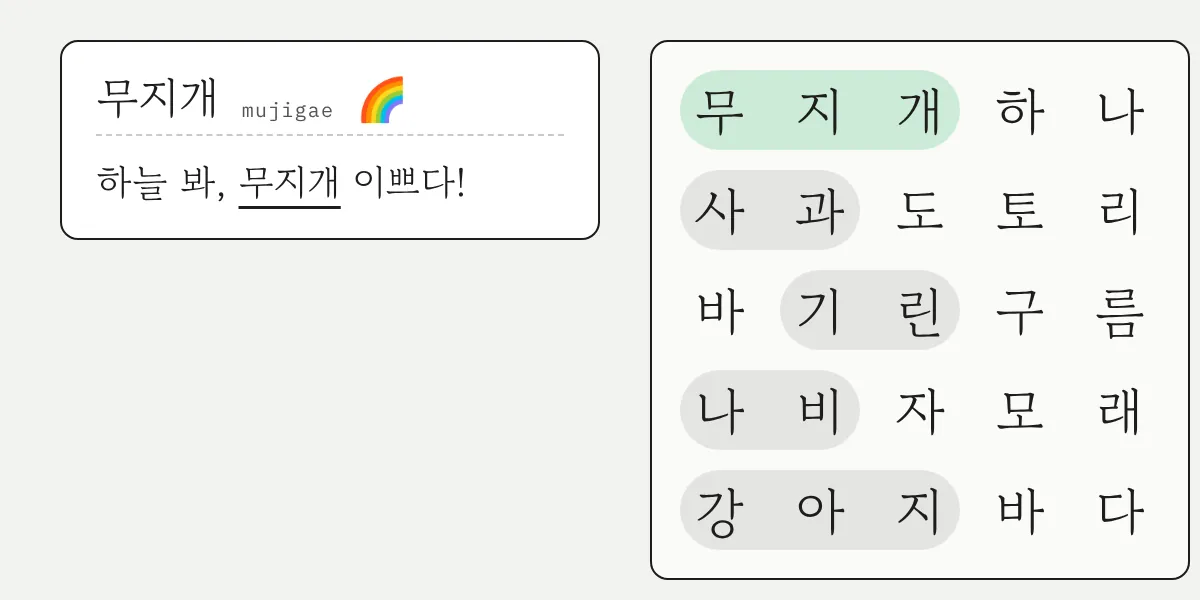
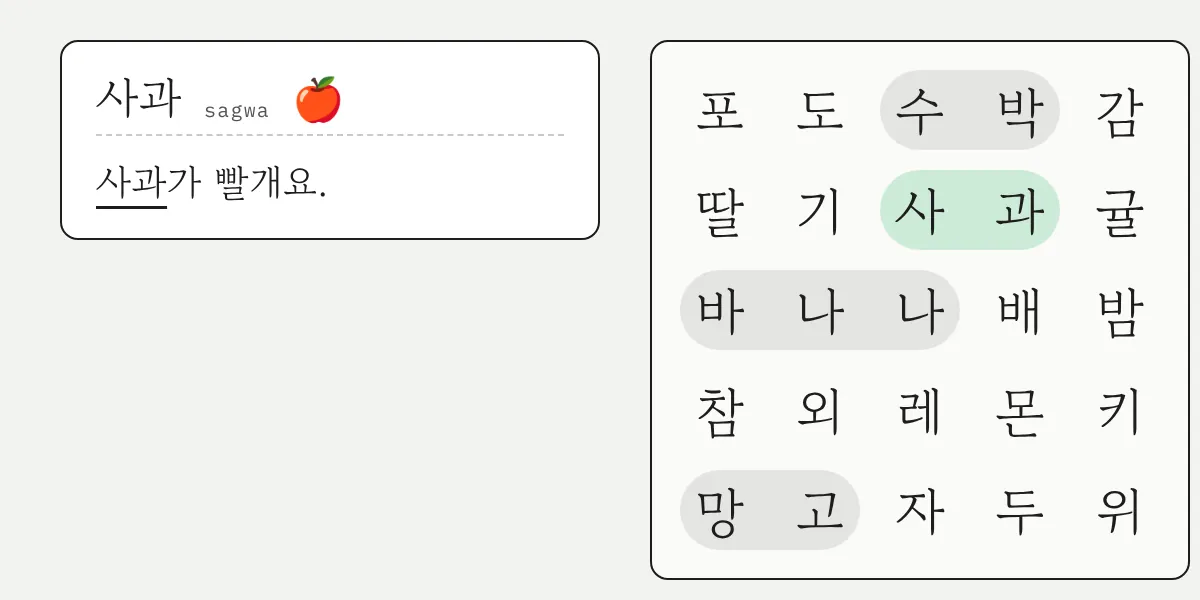
Pick a place, then find and tap the objects listed at the bottom. Each one you find gets colored in and you hear the Korean word. Stuck? Tap 💡 Hint. Zoom with two fingers or the + button.

Scenes cover Seoul landmarks (Han River park, Bukchon, Gwanghwamun, Myeongdong, Namsan, Gwangjang Market, the Amsa-dong prehistoric site, Seoul Forest, Seokchon Lake, the Lotte World Tower Christmas market, Lotte World Adventure, the National Museum of Korea, a Seoul Marathon cheering spot), day trips near Seoul (Hwadam Forest, Konjiam Luge 360, Korea National Arboretum), everyday spots (a convenience store, the subway), workplaces (a factory floor, a construction site, a farm greenhouse) and restaurants (pork rib BBQ, pork belly BBQ, a bunsik snack bar, a Korean-Chinese restaurant, a lamb skewer restaurant). You’ll meet things you really see in Korea — the cutlery drawer in the table, ordering kiosks, the pink subway seat, 1+1 deals — and every menu and sign is in Korean. New places are added over time.

Tap 💡 Hint to hear what an unfound word means, with a flashing circle near where it is; a second hint for the same word shows the exact spot. Tap any word at the bottom to read and hear about it.

On phones, pinch or press + to zoom and drag to move around. No hints earns 3 stars; one or two earns 2. Every word you find is collected in the 📖 Word book, saved on this device.

All illustrations were drawn by Vibe Lab. Pronunciation uses your browser’s Korean voice, so it may sound different on each device.

Every scene is drawn from places I have been myself or from photos I took with my kids. So when a familiar scene comes up, my kids shout “아빠, 석촌호수 우리 갔었잖아!” (Dad, we went to Seokchon Lake, remember?) and start talking about that day.

Test your Korean level ⏱ About 5 minutes · 20 questions ▶ Start the test

📚 Learn Korean with free games →

Korean words you’ll learn in the game

Show all 322 words

Every word in the game so far (322 and growing as new places are added), grouped by place, with romanized pronunciation and English meaning. Read them before you play, or use the list to review afterwards.

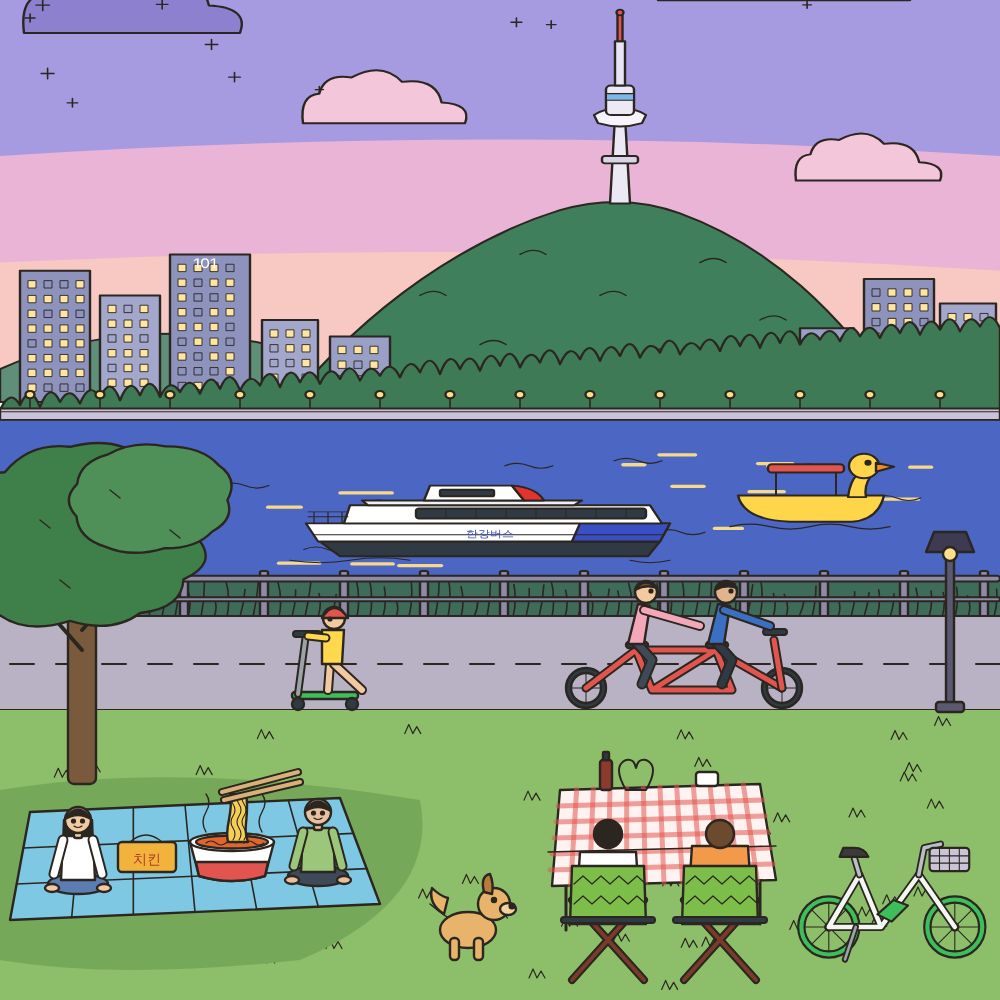
Han River Park · 한강공원

KoreanPronunciationMeaningAbout
남산타워 namsan tawo N Seoul Tower N Seoul Tower on top of Namsan — a landmark you can see from almost anywhere in Seoul.
남산 namsan Namsan (mountain) Namsan, the mountain in the middle of Seoul. San means “mountain”, so Namsan is “South Mountain”.
따릉이 ttareungi Seoul public bike Seoul’s public rental bike, easy to spot by its green wheels. The name comes from the bell sound “ttareureung”.
다리 dari bridge Bridge. More than 30 bridges cross the Han River. Dari also means “leg” — same word, two meanings!
오리배 oribae duck pedal boat A duck-shaped pedal boat you can ride on the river. Ori = duck, bae = boat.
한강라면 hangang ramyeon Han River ramyeon Instant noodles in a wide, low paper bowl, sold at Han River park convenience stores. You cook them on the spot in the ramyeon machine and eat by the river.
강아지 gangaji puppy Puppy (a young dog). In Korean, dogs say “meong-meong”!
2인용 자전거 iinyong jajeongeo tandem bike A bike for two — one rider in front, one behind, both pedaling. You can rent one at Han River parks and ride along the water.
킥보드 kikbodeu kick scooter You push off the ground with one foot to ride it. Kids in helmets zoom along the wide Han River paths.
한강버스 hangang beoseu Hangang Bus (river bus) A boat that runs like a bus on the Han River. It started service in 2025 — ride it and see Seoul from the water.

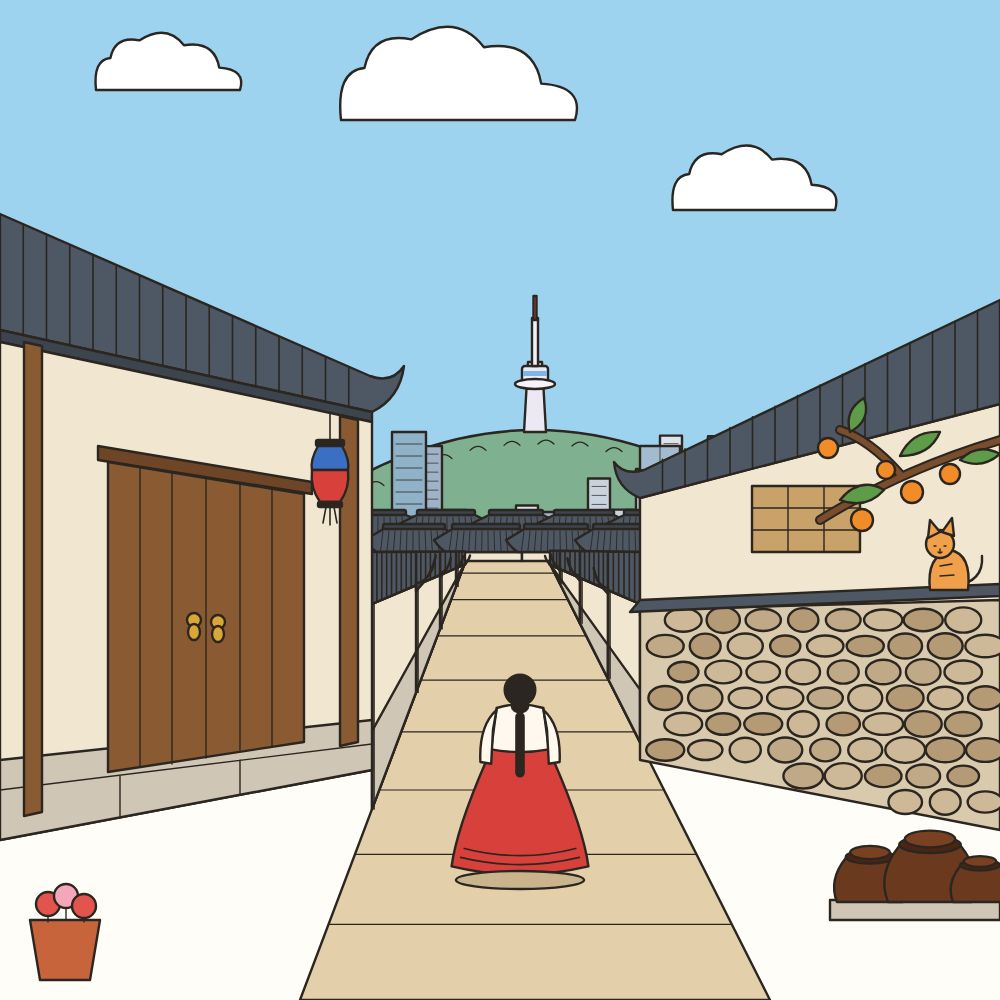
Bukchon Hanok Village · 북촌한옥마을

KoreanPronunciationMeaningAbout
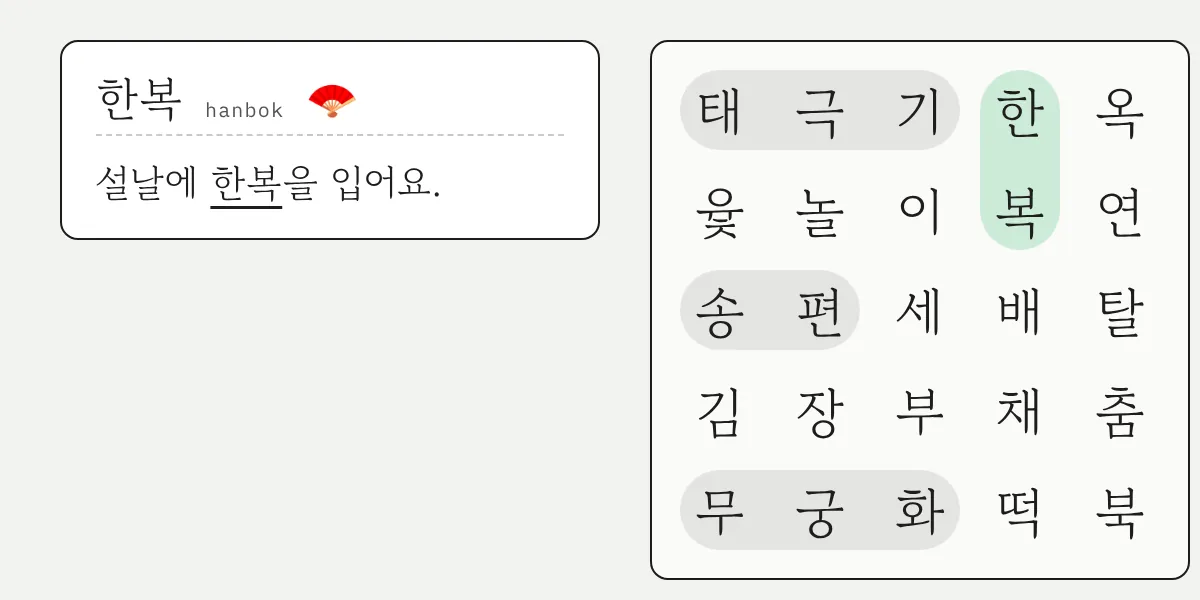
한복 hanbok traditional clothes Traditional Korean clothing: a short jacket (jeogori) and a full skirt (chima). Many visitors rent one to stroll around Bukchon.
기와 giwa roof tiles Roof tiles of fired clay. A house roofed with them is a giwajip (“tile house”).
대문 daemun main gate The main gate of a house. Hanok gates are wooden, with round metal knockers.
돌담 doldam stone wall A wall of stacked stones. Dol = stone, dam = wall.
청사초롱 cheongsachorong blue-and-red lantern A traditional lantern of blue and red silk — a symbol of welcoming guests.
장독 jangdok sauce jars Earthenware jars for soybean paste, chili paste and soy sauce. The spot where they stand is a jangdokdae.
고양이 goyangi cat Cat. Koreans call orange cats “cheese cats”. Cats say “yaong”.
감 gam persimmon Persimmon, an orange fruit that ripens in autumn. Persimmon trees are common in hanok yards.

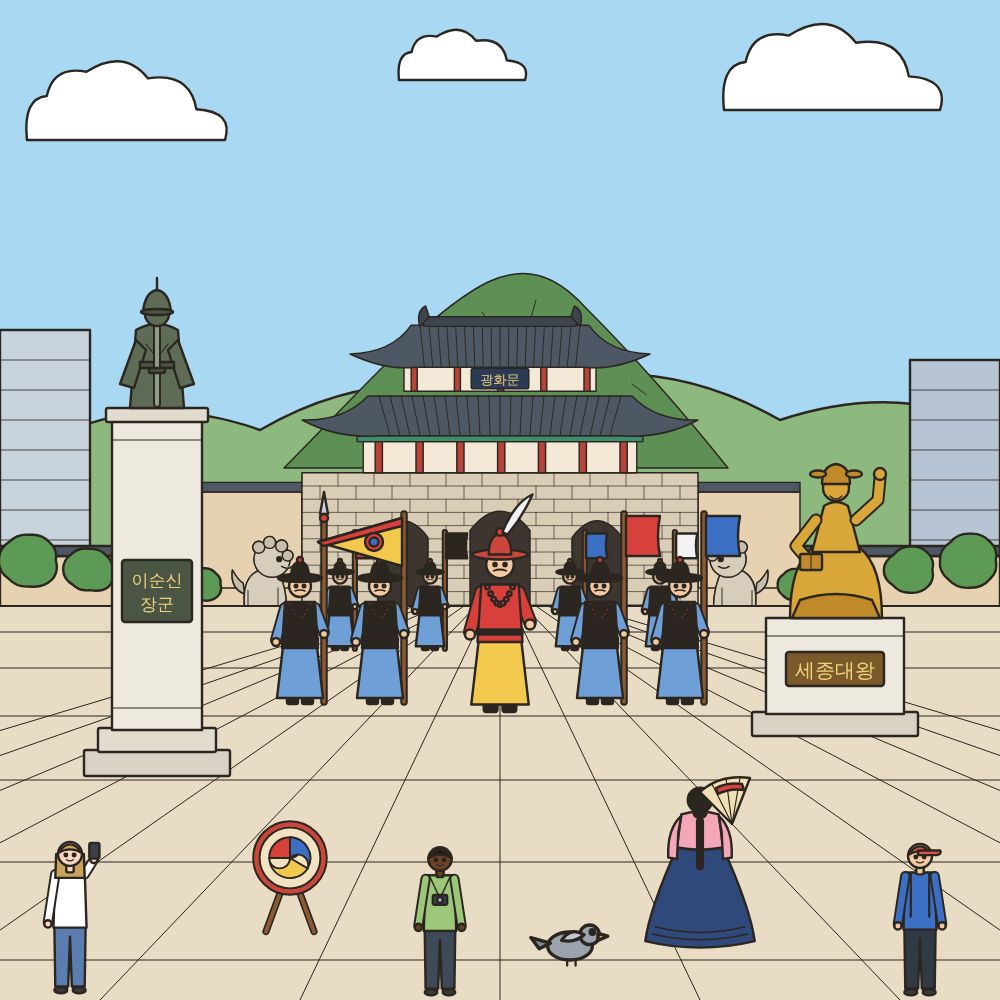
Gyeongbokgung Palace · 경복궁 광화문

KoreanPronunciationMeaningAbout
광화문 gwanghwamun Gwanghwamun Gate The main gate of Gyeongbokgung, the royal palace of the Joseon dynasty.
북악산 bugaksan Bugaksan (mountain) Bugaksan, the mountain behind the palace, believed to protect it.
해태 haetae haetae (guardian beast) Haetae (haechi), a mythical lion-like creature said to ward off fire and evil. A pair guards Gwanghwamun.
수문장 sumunjang royal gate guard The royal gate guard. A colorful changing-of-the-guard ceremony is held several times a day.
깃발 gitbal flag Flag. The guards carry bright banners during the ceremony.
북 buk drum Drum. The guard ceremony starts with the beat of a big drum.
비둘기 bidulgi pigeon Pigeon, often seen around palaces and squares. It says “gugu”.
부채 buchae hand fan A hand fan. Fun fact: visitors wearing hanbok get into the palaces for free.
세종대왕 sejong daewang King Sejong The Joseon king who created Hangeul, the Korean alphabet. A huge golden statue of him sits in Gwanghwamun Square, holding a book.
이순신 장군 i sunsin janggun Admiral Yi Sun-sin The Joseon admiral who defended Korea at sea. His statue stands on a tall pedestal in Gwanghwamun Square, holding a long sword.

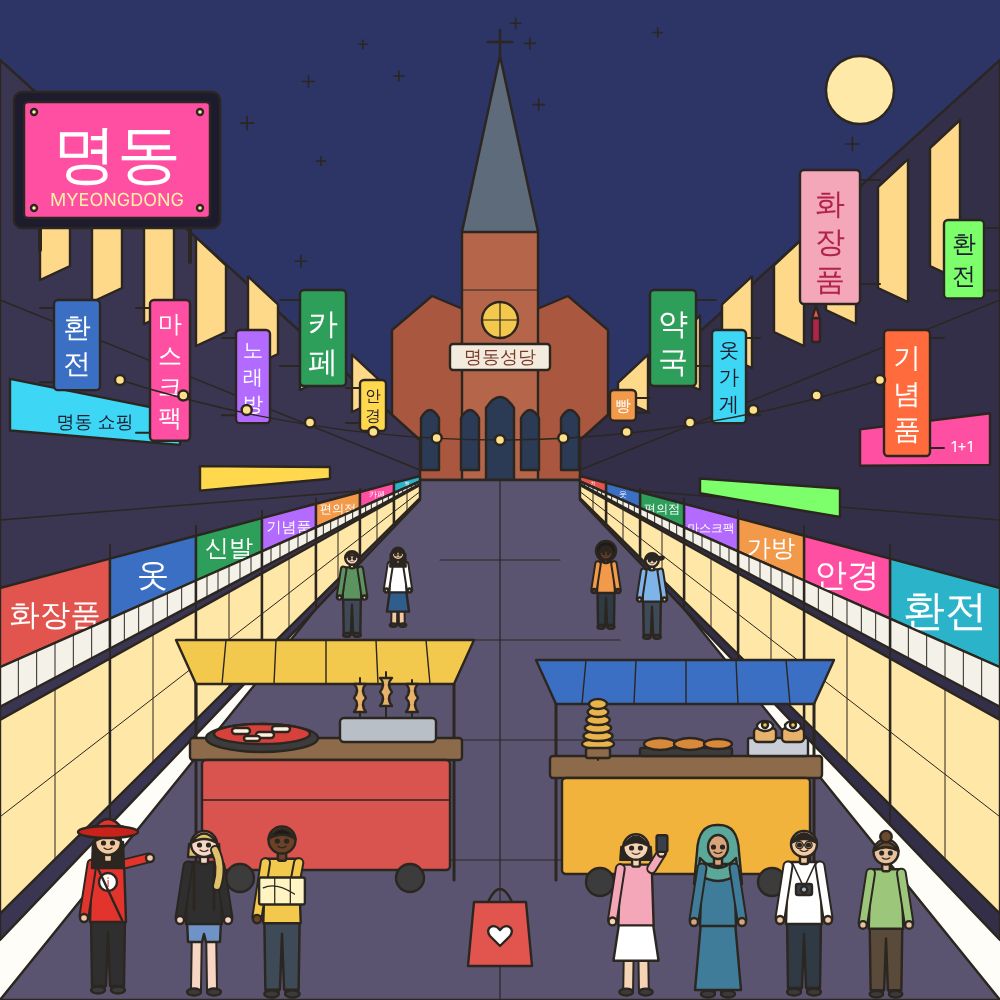
Myeongdong Street · 명동 거리

KoreanPronunciationMeaningAbout
명동성당 myeongdong seongdang Myeongdong Cathedral Myeongdong Cathedral, a red-brick Gothic church completed in 1898, with a tall pointed spire.
화장품 hwajangpum cosmetics Cosmetics. Myeongdong is packed with Korean beauty shops.
떡볶이 tteokbokki spicy rice cakes Chewy rice cakes in a sweet and spicy red chili sauce.
어묵 eomuk fish cake Fish cake on a skewer, served with hot broth.
회오리감자 hoeori gamja tornado potato A whole potato cut in a spiral on a stick and fried. Hoeori means “whirlwind”.
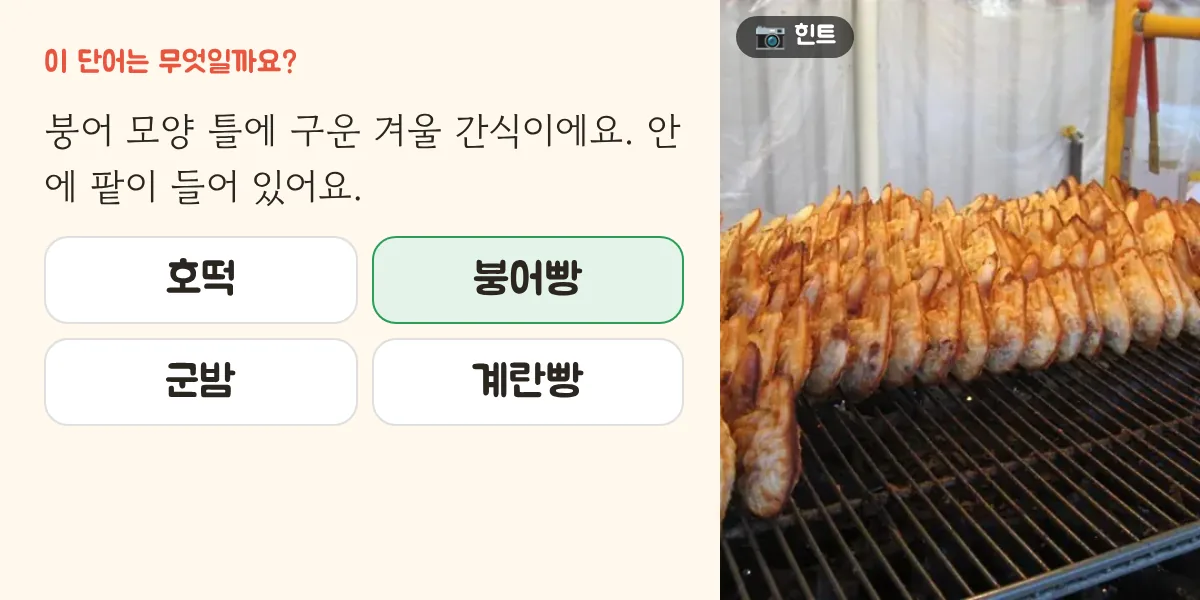
호떡 hotteok sweet pancake A sweet pancake filled with brown-sugar syrup and nuts.
계란빵 gyeranppang egg bread A small sweet loaf baked with a whole egg on top.
관광안내원 gwangwang annaewon tourist guide Guides in red hats and red shirts who stand on the street and help visitors find their way. In busy spots like Myeongdong they help in English, Japanese, Chinese and more.
쇼핑백 syopingbaek shopping bag Shopping bag — borrowed from English.
전광판 jeongwangpan LED billboard A giant electronic sign that lights up with words and pictures. At night Myeongdong glows with neon signs and billboards.

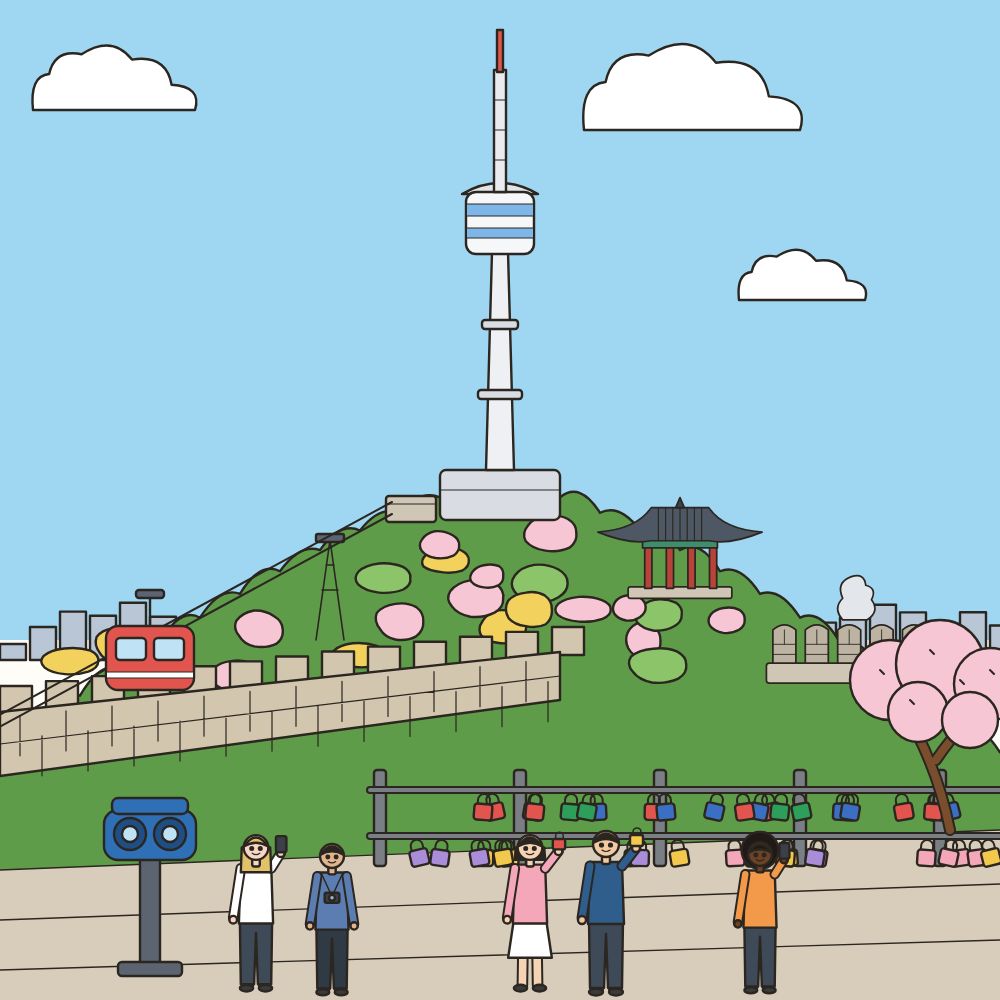
Namsan & N Seoul Tower · 남산

KoreanPronunciationMeaningAbout
남산타워 namsan tawo N Seoul Tower N Seoul Tower. From its observatory you can see all of Seoul.
케이블카 keibeulka cable car Cable car. The Namsan cable car carries you up close to the tower.
팔각정 palgakjeong octagonal pavilion An eight-sided pavilion (pal = eight) where people rest and enjoy the view.
봉수대 bongsudae beacon station A beacon station. In the Joseon era, fire and smoke signals carried news across the country; Namsan’s has five chimneys.
성곽 seonggwak fortress wall Fortress wall. Part of Seoul’s 600-year-old city wall runs along Namsan.
자물쇠 jamulsoe padlocks Padlocks. Couples hang “love locks” on the fences at N Seoul Tower.
망원경 mangwongyeong telescope A coin-operated viewing telescope.
벚꽃 beotkkot cherry blossoms Cherry blossoms. Namsan’s roads are lined with them every spring.

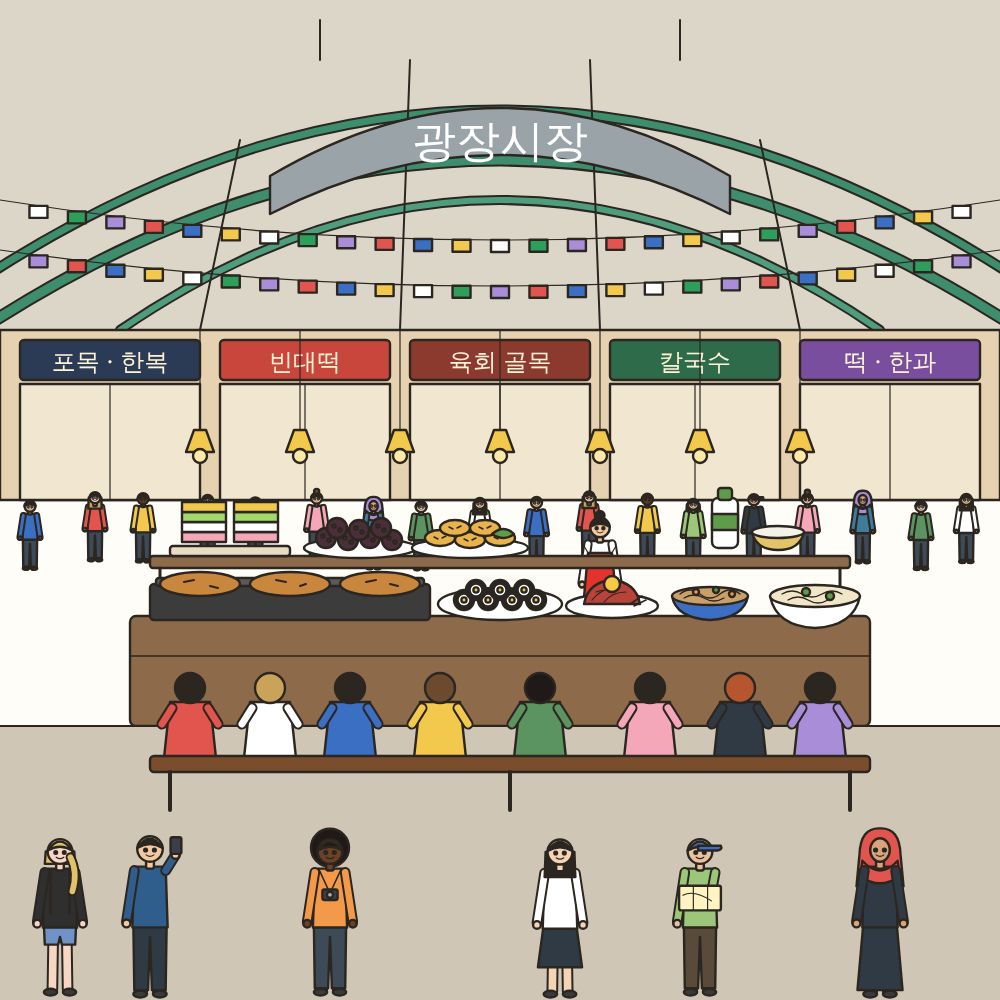
Gwangjang Market · 광장시장

KoreanPronunciationMeaningAbout
간판 ganpan signboard Signboard. Gwangjang Market, opened in 1905, is one of Korea’s oldest markets.
빈대떡 bindaetteok mung-bean pancake A crispy pancake of ground mung beans, Gwangjang Market’s signature dish.
꼬마김밥 kkoma gimbap mini gimbap Finger-sized gimbap rolls. Kkoma means “little one”.
칼국수 kalguksu knife-cut noodles Noodles cut by knife (kal) and served in warm broth.
떡 tteok rice cake Rice cake made from steamed rice flour. The layered colorful one is rainbow rice cake.
육회 yukhoe beef tartare Thin strips of raw beef topped with egg yolk and pear. Gwangjang Market is so famous for it there is a whole yukhoe alley.
순대 sundae Korean blood sausage A steamed Korean sausage filled with glass noodles and more. It is sliced into rounds and dipped in salt.
잡채 japchae glass noodle stir-fry Sweet potato glass noodles stir-fried with vegetables and meat — a favorite at parties and holidays.
막걸리 makgeolli rice wine A milky rice wine — a grown-ups-only drink. Many people enjoy it with mung-bean pancakes.
모둠전 modum jeon assorted pan-fried bites A plate of jeon — vegetables and meat coated in flour and egg, then pan-fried. At the market you pick the ones you like.

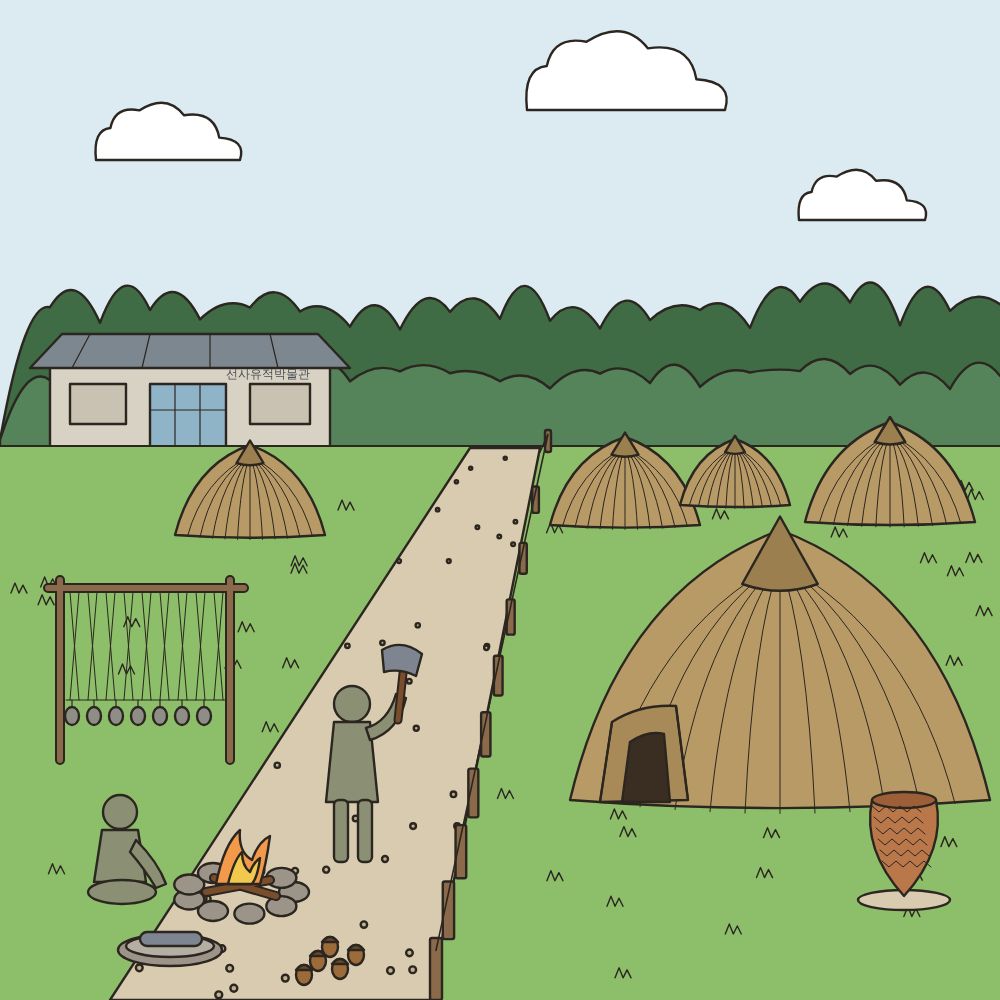
Amsa-dong Prehistoric Site · 암사동 선사유적

KoreanPronunciationMeaningAbout
움집 umjip pit house A pit house: dug into the ground, with wooden poles and a thatched roof. Neolithic people lived here about 6,000 years ago.
빗살무늬토기 bitsal munui togi comb-pattern pottery Pottery decorated with lines like the teeth of a comb. Its pointed bottom was pushed into the sand to stand up. It is the signature pottery of Korea’s Neolithic age.
화덕 hwadeok hearth The hearth in the middle of a pit house, used for cooking and keeping warm.
갈돌과 갈판 galdol-gwa galpan grinding stones Grain or acorns were placed on the flat stone (galpan) and ground into flour with the hand stone (galdol).
돌도끼 doldokki stone axe A polished stone axe for cutting and shaping wood.
그물추 geumulchu net sinkers Stone weights tied to a fishing net so it sinks. The people of Amsa-dong fished in the nearby Han River.
도토리 dotori acorns Acorns. Neolithic people gathered and ground them for food — and Koreans still eat acorn jelly (dotorimuk) today.
박물관 bangmulgwan museum A museum. Here you can see house sites and pottery that were dug up from the ground.

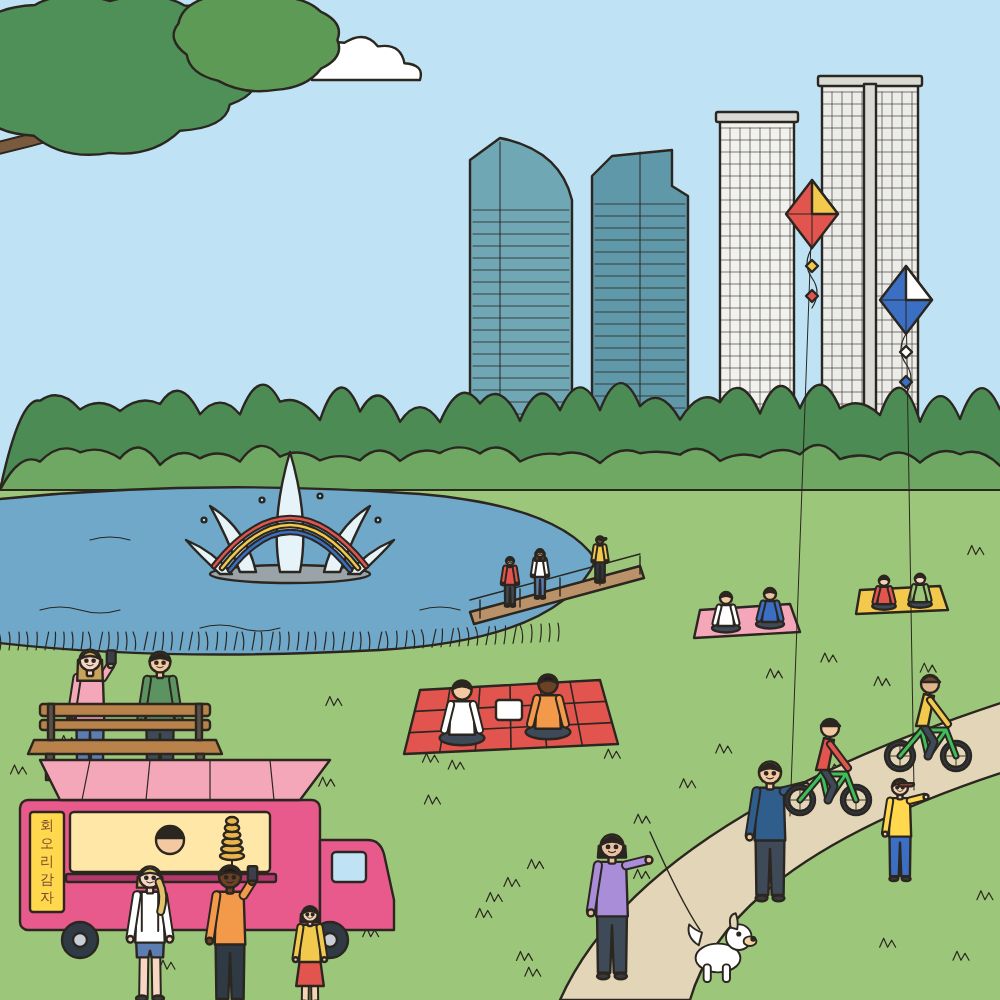
Seoul Forest · 서울숲

KoreanPronunciationMeaningAbout
호수 hosu lake A wide body of still water. Seoul Forest’s lake has a fountain and a wooden bridge — perfect for a stroll.
분수 bunsu fountain Water shooting high into the air. On sunny days you can sometimes spot a little rainbow in the spray.
연 yeon kite A toy you fly high in the wind. The wide lawn is a perfect place to fly one.
강아지 gangaji puppy A little dog. Lots of people walk their dogs in Seoul Forest.
자전거 jajeongeo bicycle You can ride along the paths around the park. Since 2026 the inner paths are walkers-only, so you push your bike there.
푸드트럭 pudeu teureok food truck A truck that sells food. On festival days people line up in front of the trucks to order.
회오리감자 hoeori gamja tornado potato A potato cut into one long spiral on a stick and fried. A favorite at the food trucks.
벤치 benchi bench A long seat for several people. Many people relax on the benches by the lake.
돗자리 dotjari picnic mat A mat you spread on the ground. In spring the lawn fills up with people picnicking on mats.
고층 빌딩 gocheung bilding skyscraper A very tall building. Seoul Forest is ringed by towers, so you see forest and city together.

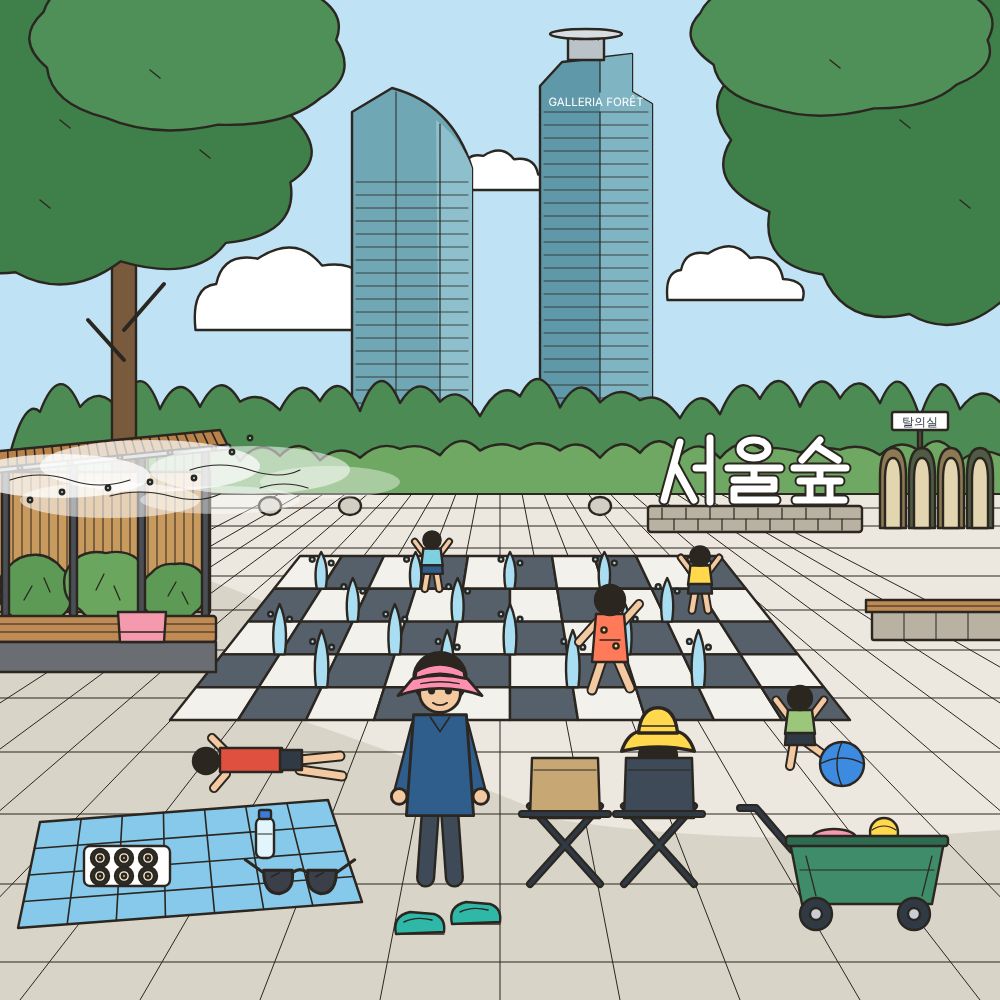
Seoul Forest – Floor Fountain · 서울숲 - 바닥분수

KoreanPronunciationMeaningAbout
바닥분수 badak bunsu floor fountain A fountain that shoots up from the ground. From May to October it runs 30 minutes every hour — in the break, some kids lie on the warm stones to dry off.
고층 빌딩 gocheung bilding skyscraper A very tall building. The twin glass towers behind the fountain are Galleria Forêt, an apartment complex — forest and city in one view.
간판 ganpan sign A sign showing the name of a place. At Seoul Forest the name stands in giant white letters on a low stone wall. Sup means “forest”.
캠핑의자 kaemping uija camping chair A folding chair. Tents and sunshades aren’t allowed, so people carry chairs and move them into the shade.
모자 moja hat Something you wear on your head. The summer sun is strong, so kids wear hats too.
선캡 seonkaep sun visor A cap with only a brim. Koreans call it seonkaep — “sun” + “cap”.
선글라스 seongeullaseu sunglasses Glasses that protect your eyes from bright sun. Someone left theirs on the picnic mat!
돗자리 dotjari picnic mat A mat you spread on the ground. Lay it in the shade to eat gimbap — food delivery even comes into the park.
카트 kateu folding wagon A wagon you pull along. Chairs, mats, towels and snacks all fit in one trip.
수영복 suyeongbok swimsuit What you wear to play in water. Put it on at home and you can run straight into the fountain. Grown-ups often wear rash guards.

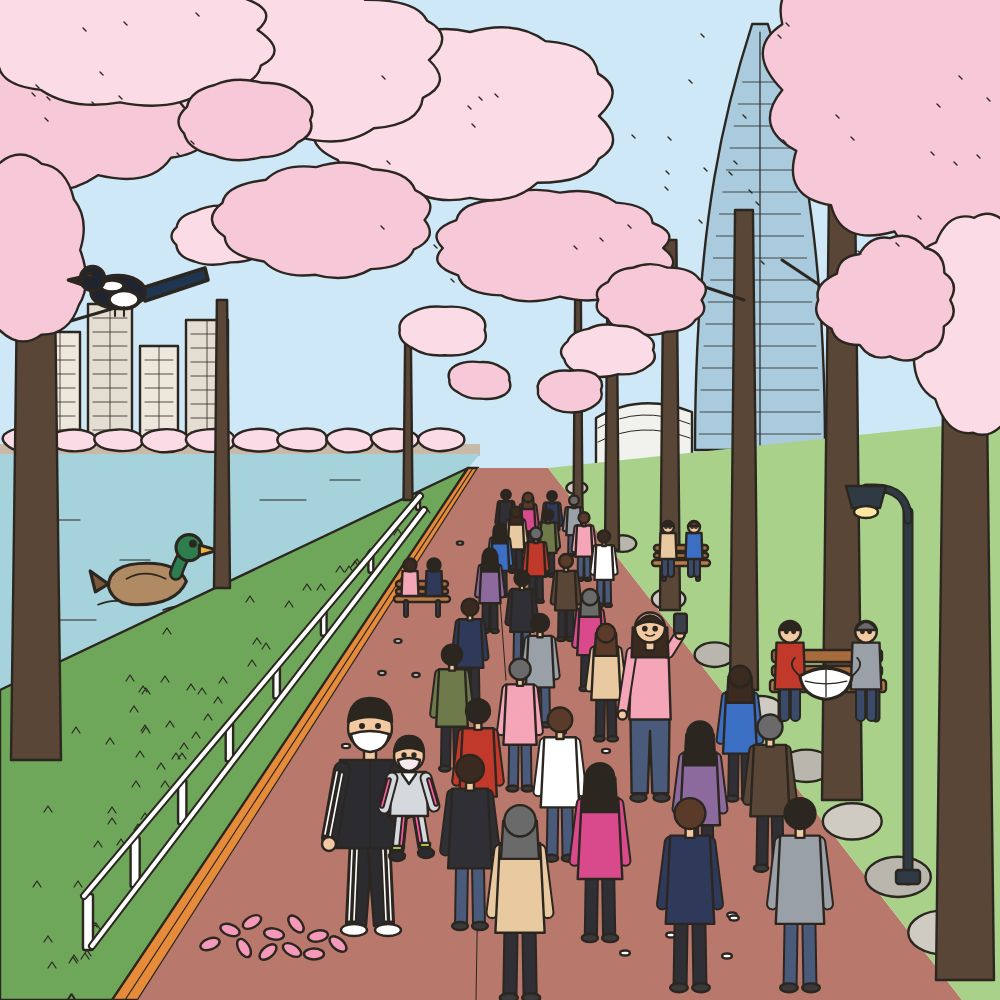
Seokchon Lake – Cherry Blossom Path · 석촌호수 - 벚꽃 산책길

KoreanPronunciationMeaningAbout
롯데월드타워 lotte woldeu tawo Lotte World Tower Korea’s tallest building (555 m), right beside Seokchon Lake — you can see it from anywhere around the water.
꽃잎 kkonnip petals When the cherry blossoms fall, petals cover the path like a carpet.
트레이닝복 teureining-bok tracksuit A matching top-and-bottom sportswear set. That day, dad and son wore matching tracksuits for their walk.
마스크 maseukeu face mask In Korea many people wear masks in spring on days with yellow dust or heavy fine dust (PM2.5).
가로등 garodeung street lamp Lights the walking path. At night the cherry trees are lit up too.
오리 ori duck Ducks float lazily on Seokchon Lake.
셀카 selka selfie Short for “self camera” in Korean. There are great photo spots all around the lake.
아파트 apateu apartment buildings In Korea “apateu” means high-rise apartment blocks — there are many around the lake.
까치 kkachi magpie A black-and-white bird common in Korea, long said to bring good news.
난간 nangan railing The barrier between the lake and the path.

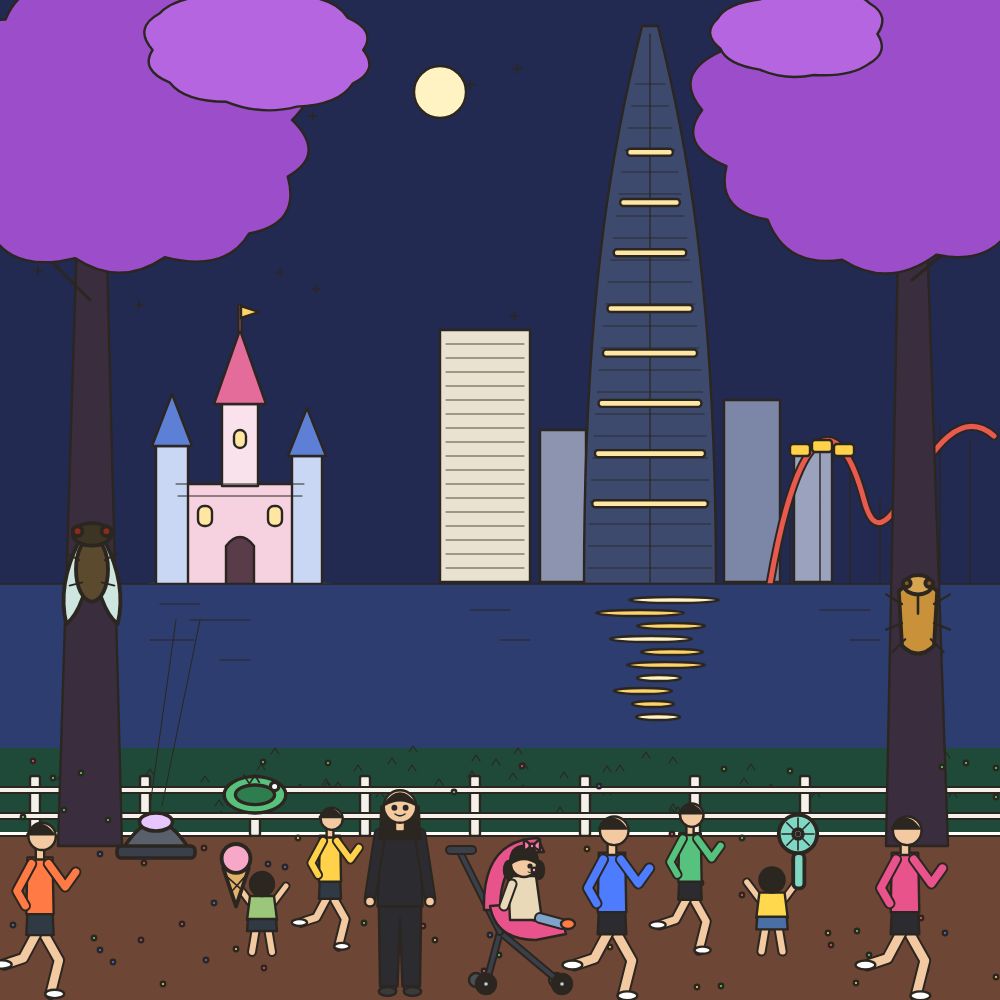
Seokchon Lake – Summer Night Lights · 석촌호수 - 여름밤 불빛 산책

KoreanPronunciationMeaningAbout
매미 maemi cicada In summer the trees around the lake are full of cicadas. Kids love it when you catch one for them.
매미 허물 maemi heomul cicada shell The empty shell a cicada leaves behind when it becomes an adult. In summer you can find lots on tree trunks.
유모차 yumocha stroller A pushchair for babies and small children.
윤슬 yunseul shimmering reflections A lovely Korean word for light glittering on water. At night the building lights shimmer on the lake.
놀이공원 nori gongwon amusement park There’s an amusement park right by the lake — you can see its castle on an island in the water.
롤러코스터 rolleo koseuteo roller coaster From the lakeside you can also see the amusement park’s roller coaster tracks.
모기 팔찌 mogi palji mosquito repellent bracelet A must for summer night walks — wear it on your wrist to keep mosquitoes away.
손선풍기 son seonpunggi handheld fan A small fan you hold in your hand — you see them everywhere in a Korean summer.
아이스크림 aiseukeurim ice cream The perfect treat for a hot summer walk.
조명 jomyeong lighting At night the lakeside trees glow purple and pink, and colorful dots of light dance on the path.

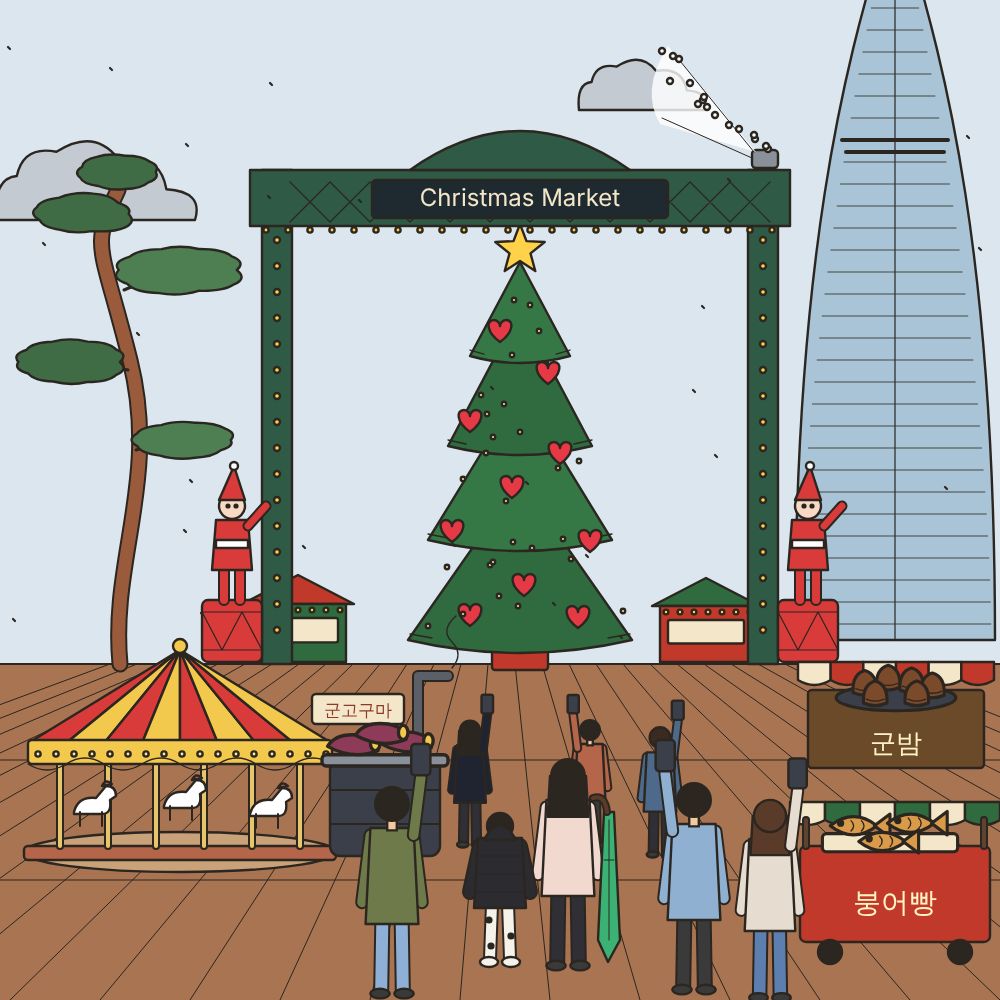
Lotte World Tower – Christmas Market · 롯데월드타워 - 크리스마스 마켓

KoreanPronunciationMeaningAbout
크리스마스트리 keuriseumaseu teuri Christmas tree Around Christmas a huge tree goes up in the plaza in front of Lotte World Tower. The decorations may change every year.
회전목마 hoejeon mongma carousel The merry-go-round with wooden horses — sometimes there’s one at the Christmas market, twinkling with lights.
인공눈 ingongnun artificial snow Fake snow that flutters down like the real thing — everyone held up their phones to film it.
우산 usan umbrella What you carry for rain or snow.
패딩 paeding puffer jacket In Korea a puffy winter coat is called “paeding” (from padding).
붕어빵 bungeoppang fish-shaped pastry (bungeoppang) A fish-shaped winter snack filled with sweet red bean paste. Winter isn’t winter without it!
소나무 sonamu pine tree Korea’s iconic tree — it stays green even in winter.
별 byeol star The star on top of the Christmas tree.
군밤 gunbam roasted chestnuts Roasted chestnuts sold at winter street stalls — warm your hands on the paper bag as you eat.
군고구마 gungoguma roasted sweet potatoes Sweet potatoes roasted in a drum oven — a classic Korean winter snack.

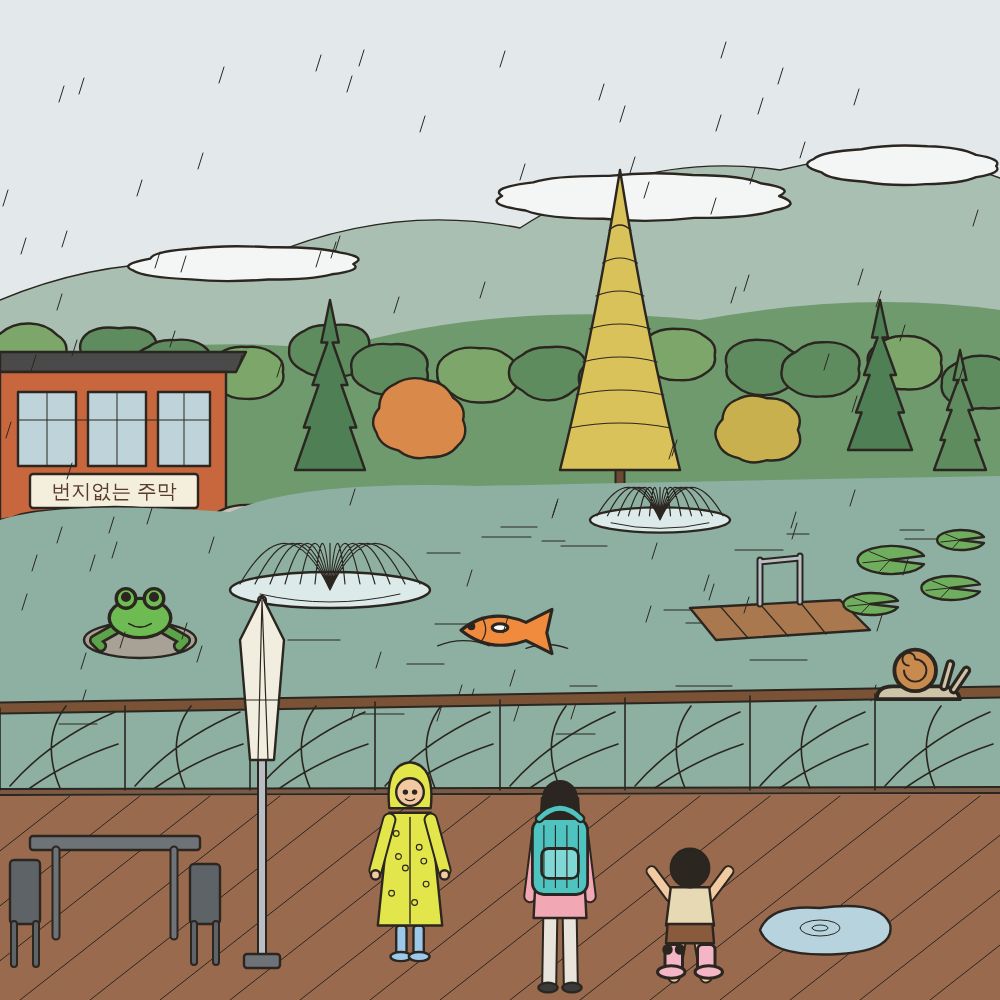
Hwadam Forest – Pond in the Rain · 화담숲 - 비 오는 연못

KoreanPronunciationMeaningAbout
우비 ubi raincoat A coat you wear over your clothes in the rain. Our son wore a yellow raincoat covered in frogs.
장화 janghwa rain boots Tall boots — no need to worry about puddles.
연잎 yeonnip lotus leaf The wide, round leaf of a lotus — raindrops roll right off it.
메타세쿼이아 metasekwoia dawn redwood (metasequoia) A tall, cone-shaped tree. At the end of September at Hwadam it was just starting to turn yellow.
잉어 ingeo carp (koi) A big fish that lives in ponds and rivers. Some are colorful, orange or white.
파라솔 parasol patio umbrella A big umbrella for a terrace table. It was folded up on the rainy day.
배낭 baenang backpack A bag you carry on your back — handy on forest trails because both hands stay free.
물웅덩이 mul ungdeongi puddle Water that collects on the ground after rain. In rain boots — splash!
달팽이 dalpaengi snail An animal that comes out on rainy days, carrying its house on its back.
개구리 gaeguri frog A green animal that lives by the water. In Korean it croaks “gaegul gaegul.”

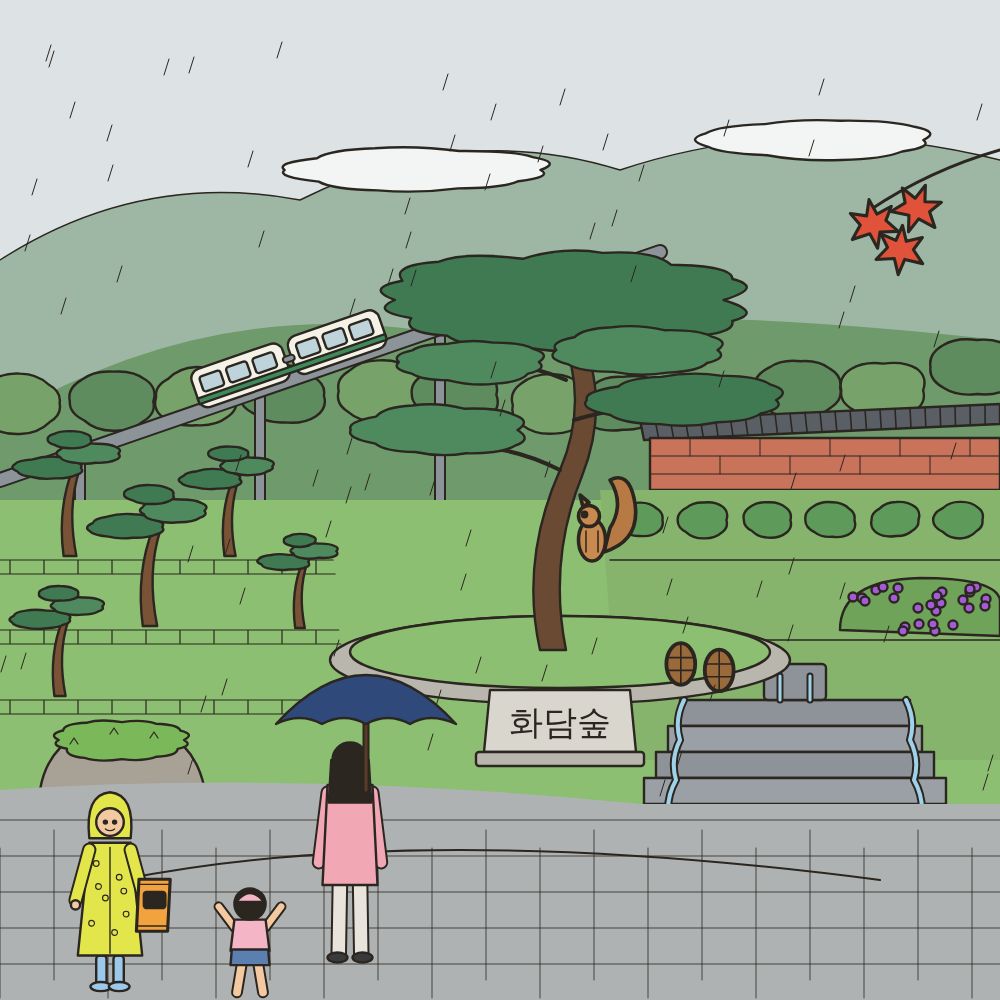
Hwadam Forest – Pine Garden & Monorail · 화담숲 - 소나무 정원과 모노레일

KoreanPronunciationMeaningAbout
모노레일 monoreil monorail A train that runs on a single rail. We rode it to the top and walked back down.
표지석 pyojiseok name stone (stone sign) A big stone carved with the name of a place. At Hwadam’s entrance plaza, everyone takes a photo in front of it.
솔방울 solbangul pine cone The cone of a pine tree — seeds hide between its scales.
담장 damjang wall (hanok wall) A wall around a house or garden. A hanok-style wall with a tiled top wrapped around the garden.
꽃밭 kkotbat flower bed A patch planted with flowers. Purple flowers were in full bloom, wet with rain.
돌계단 dolgyedan stone steps Steps made of stone. Water trickled down both sides.
이끼 ikki moss A tiny green plant that grows in shady, damp places — it looks extra fresh on a rainy day.
다람쥐 daramjwi chipmunk A small striped animal that stuffs its cheeks with acorns.
단풍잎 danpungnip maple leaf A leaf that turns red in autumn. At the end of September most were still green, with only a few red ones.
과자 gwaja snack A crunchy treat. Our son walked around in his raincoat clutching a bag of snacks.

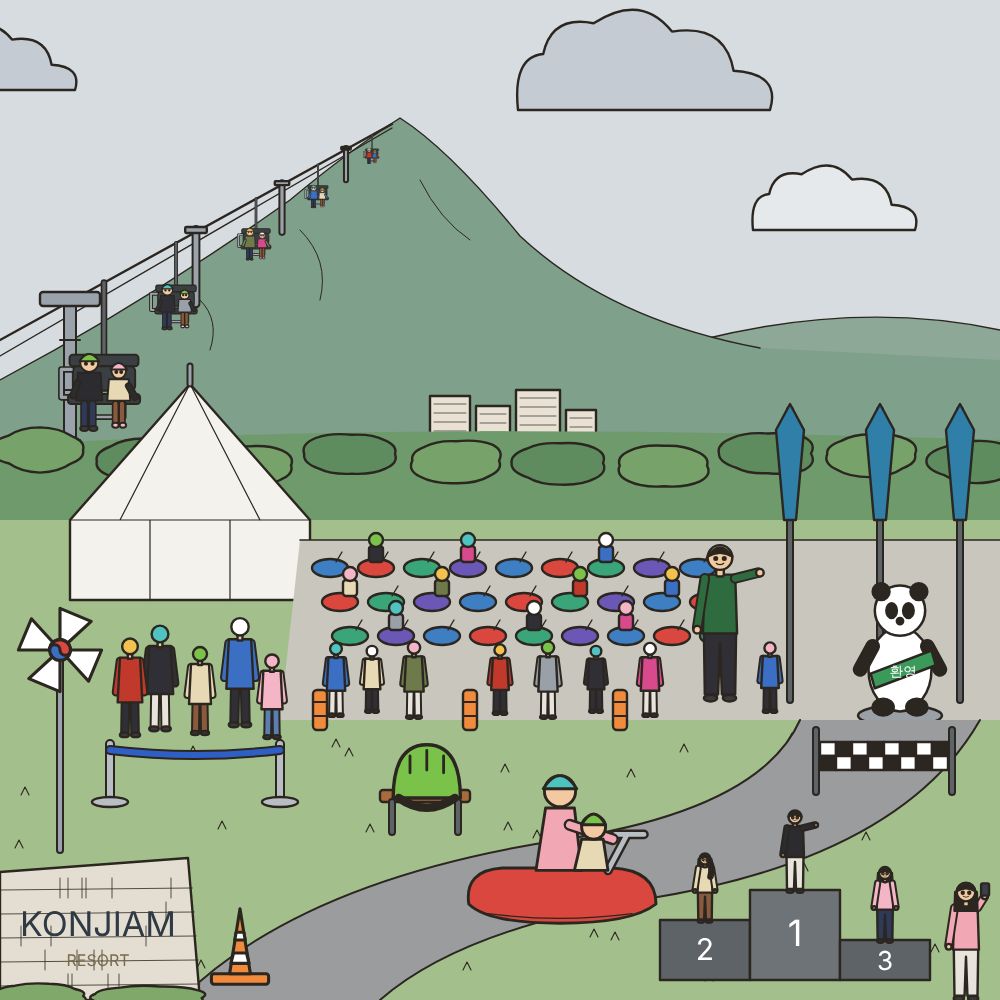
Konjiam – Luge 360 · 곤지암 - 루지 360

KoreanPronunciationMeaningAbout
루지 ruji luge (downhill cart) Riding a wheeled cart down a slope. Dad rode with our son, and Mom with our daughter.
헬멧 helmet helmet A hard hat that protects your head — you always wear one on the luge.
리프트 rifeuteu chairlift You ride a chair hanging from a cable up the mountain. We took the chairlift up to the luge start.
텐트 tenteu tent A cloth shelter shaped like a little house — its pointy roof stands out from far away.
안전요원 anjeonyowon safety staff A person who makes sure nobody gets hurt.
판다 panda panda A black-and-white bear. There were panda statues at the luge area, so we took photos with them.
출발선 chulbalseon starting line The line where a race begins — it’s often painted in a checkered pattern.
바람개비 baramgaebi pinwheel A toy that spins when the wind blows. Pinwheels with the taegeuk symbol lined the path.
시상대 sisangdae winners’ podium The stand where 1st, 2nd and 3rd place stand — the middle spot for 1st is the highest.
라바콘 rabakon traffic cone An orange cone for blocking or guiding traffic. Koreans often call it “rabakon” (from rubber cone).

Korea National Arboretum – Maple Path · 국립수목원 - 단풍길

KoreanPronunciationMeaningAbout
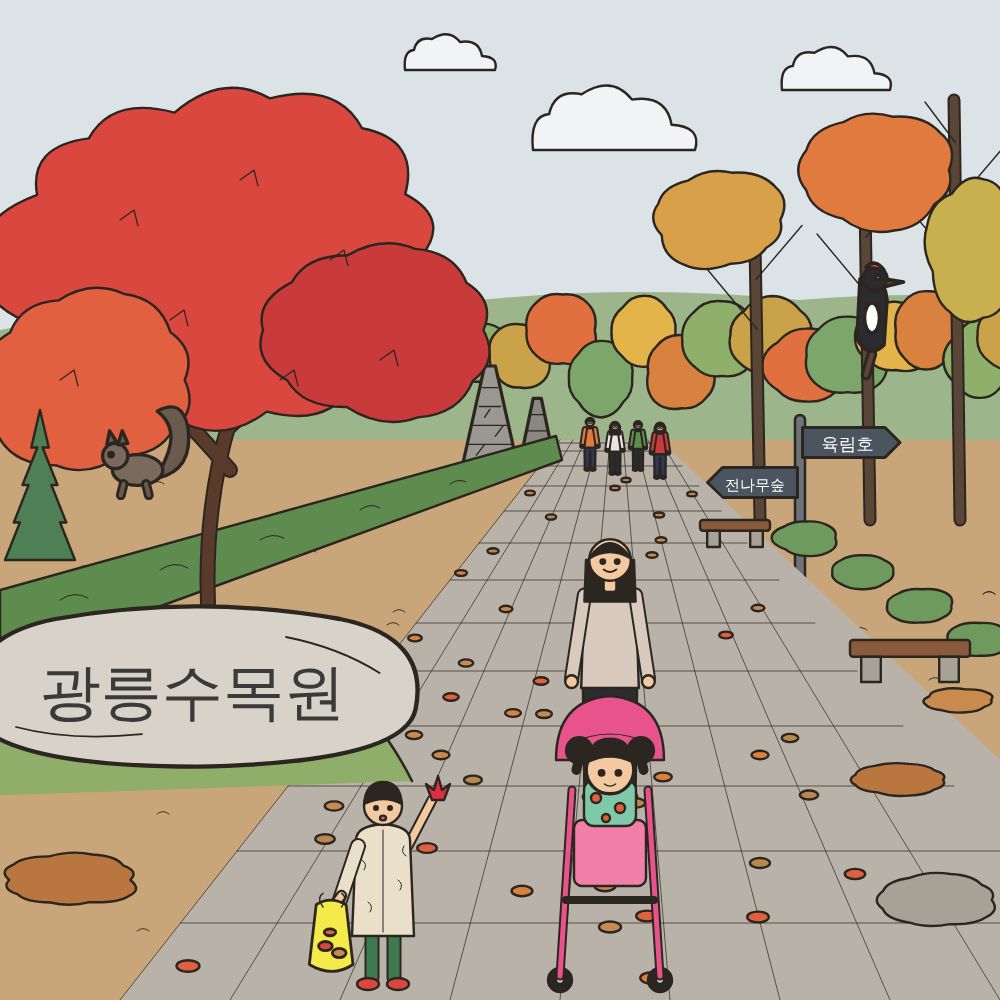
단풍나무 danpungnamu maple tree A tree whose leaves turn red in autumn. Along the paths of the National Arboretum, red maples spread their branches almost over the whole path.
비닐봉지 binil bongji plastic bag Our son carried a yellow plastic bag and filled it with the fallen leaves he picked up.
회양목 hoeyangmok boxwood hedge A small-leaved shrub trimmed low into a hedge. It lines the edges of the arboretum paths.
유모차 yumocha stroller A pushchair for babies and small children. The wide paths of the arboretum were fine with a stroller.
청설모 cheongseolmo red squirrel (Korean squirrel) A grey-brown squirrel often seen in Korean forests and parks, with tufts of fur on its ear tips.
딱따구리 ttakttaguri woodpecker A bird that taps tree trunks with its beak to find insects. Its Korean name comes from the sound "ttak ttak".
이정표 ijeongpyo signpost A sign with arrows that tells you which way to go. In the arboretum, signposts point to Yungnim Pond, the fir forest and more.
돌탑 doltap stone tower A tower made by stacking stones. In the arboretum's garden stand stone towers shaped like pointed hats.
후리스 huriseu fleece jacket A fluffy, warm jacket. Koreans say "huriseu" for the English word fleece. Our son wore a beige one.
양갈래 머리 yanggallae meori pigtails Hair split into two and tied on each side. Our daughter wore pigtails in her stroller.

National Museum of Korea – Central Hall · 국립중앙박물관 - 중앙홀

KoreanPronunciationMeaningAbout
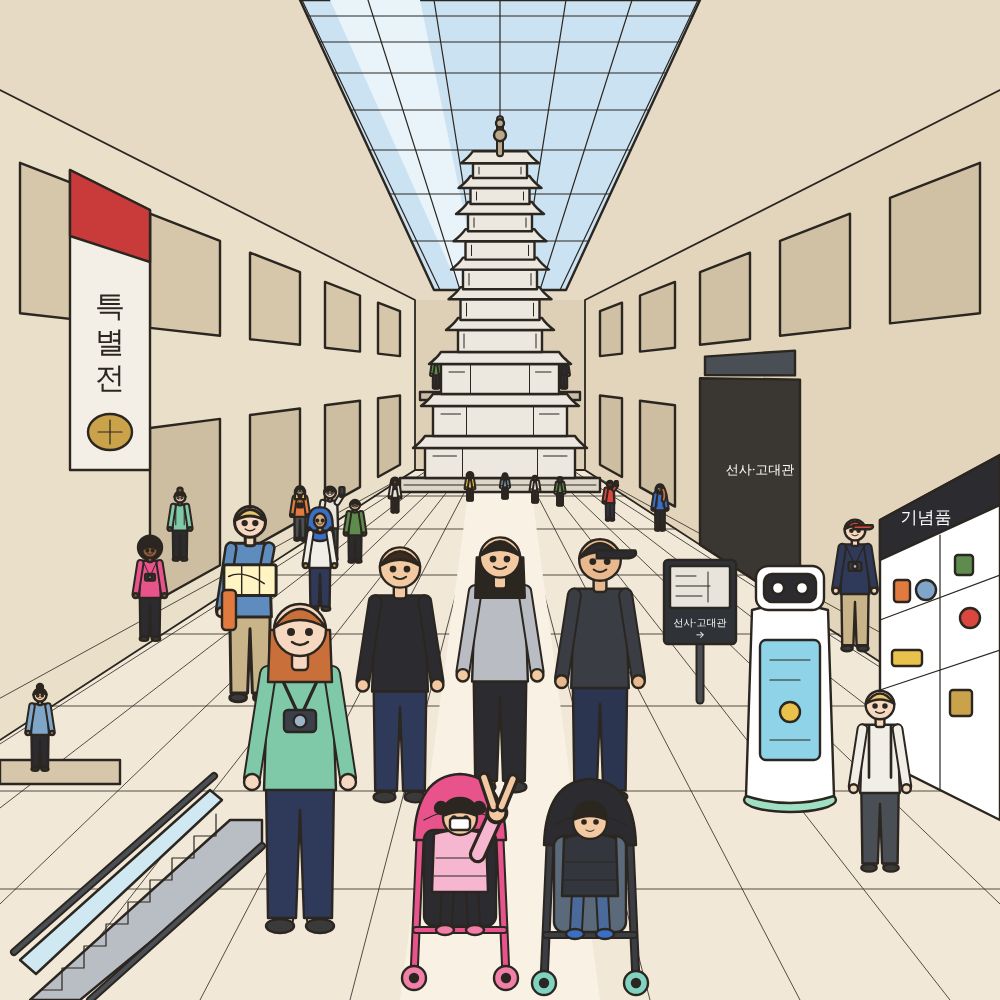
유리 천장 yuri cheonjang glass ceiling The roof of the museum’s central hall is glass, so daylight pours down the long hall.
현수막 hyeonsumak banner A long cloth banner on the wall announcing new shows, like a “special exhibition”.
기념품 가게 ginyeompum gage souvenir shop A shop selling goods inspired by the museum’s treasures — here it’s called the Museum Shop.
안내판 annaepan information sign A sign telling you what is where. Galleries like Prehistoric and Ancient History open off both sides of the central hall.
관광객 gwangwanggaek tourist A visitor on a trip. There were far more foreign tourists than the last time we came.
안내 로봇 annae robot guide robot A robot that rolls around the museum giving directions. Our kids were scared at first, then followed it everywhere.
할머니 halmeoni grandma Mom’s or Dad’s mother. In autumn we visited the museum with Grandma and Grandpa.
할아버지 harabeoji grandpa Mom’s or Dad’s father. Grandpa pushed his grandson’s stroller.
브이 beui V sign The two-finger V pose for photos. Our daughter made one from her stroller.
경천사지 십층석탑 gyeongcheonsaji sipcheung seoktap Ten-story Stone Pagoda from Gyeongcheonsa Temple Site A marble pagoda about 13.5 m tall standing at the end of the central hall — made in the Goryeo era and the museum’s signature treasure.

National Museum of Korea – Prehistoric & Ancient Gallery · 국립중앙박물관 - 선사·고대관

KoreanPronunciationMeaningAbout
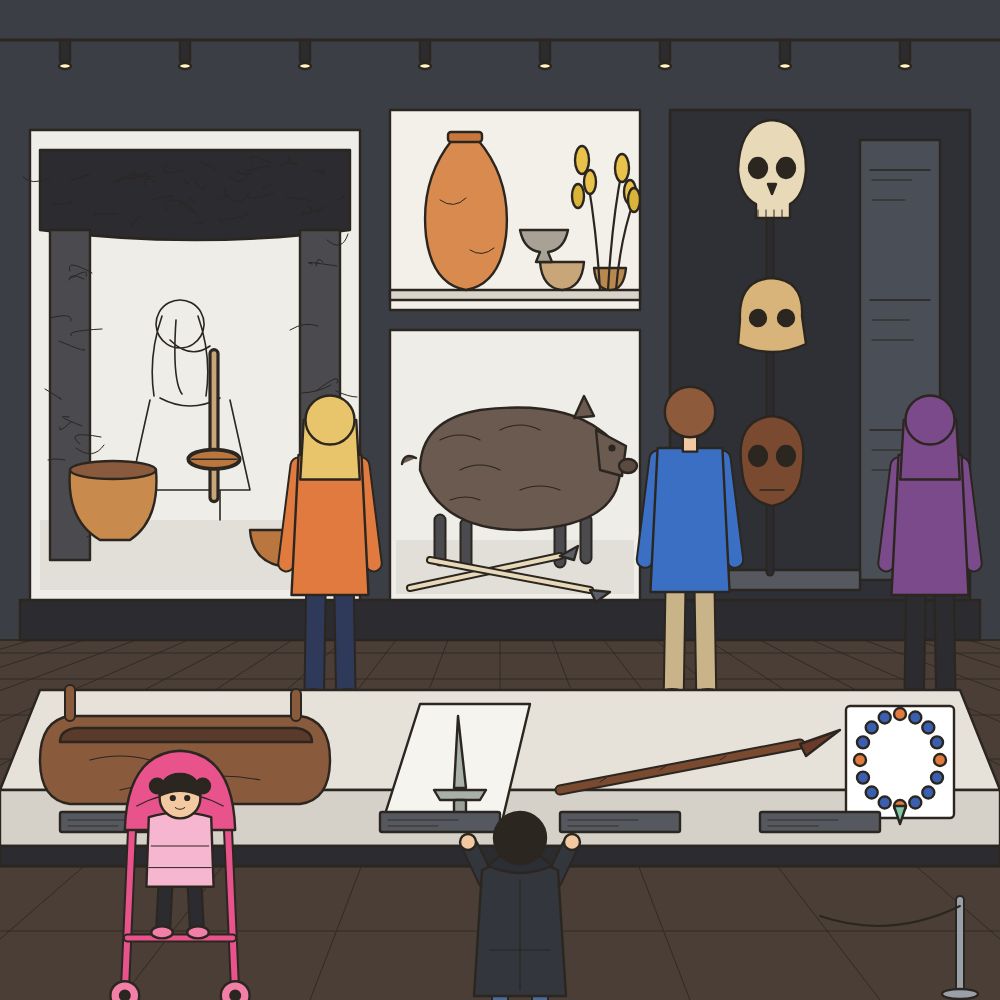
가락바퀴 garakbakwi spindle whorl A stone or clay disc spun on a stick to make thread. In the gallery, a woman drawn in wire is spinning thread.
민무늬토기 minmunui togi plain pottery Bronze Age pottery with no pattern, used after the comb-pattern pottery era.
벼 byeo rice plant The plant that gives us rice. Wire rice stalks stood next to the pottery.
멧돼지 metdwaeji wild boar A wild pig of the mountains. The gallery had a wire boar and hunting arrows.
화살 hwasal arrow A thin shaft shot from a bow. Long ago people tipped it with polished stone.
머리뼈 meoribyeo skull The bones of the head. Replica skulls stand in order, from Australopithecus to Homo sapiens.
통나무 관 tongnamu gwan log coffin A coffin carved from a hollowed-out log — this one comes from a tomb at Daho-ri, Changwon.
간돌검 gandolgeom polished stone dagger A dagger made of polished stone, thought to show a leader’s power in the Bronze Age.
쇠창 soechang iron spear A long spear of iron, now rusted brown with age.
구슬 목걸이 guseul mokgeori bead necklace A necklace of tiny beads — blue and orange strings from Silla tombs are on display.

National Museum of Korea – Rainy-Day Plaza · 국립중앙박물관 - 비 오는 날 마당

KoreanPronunciationMeaningAbout
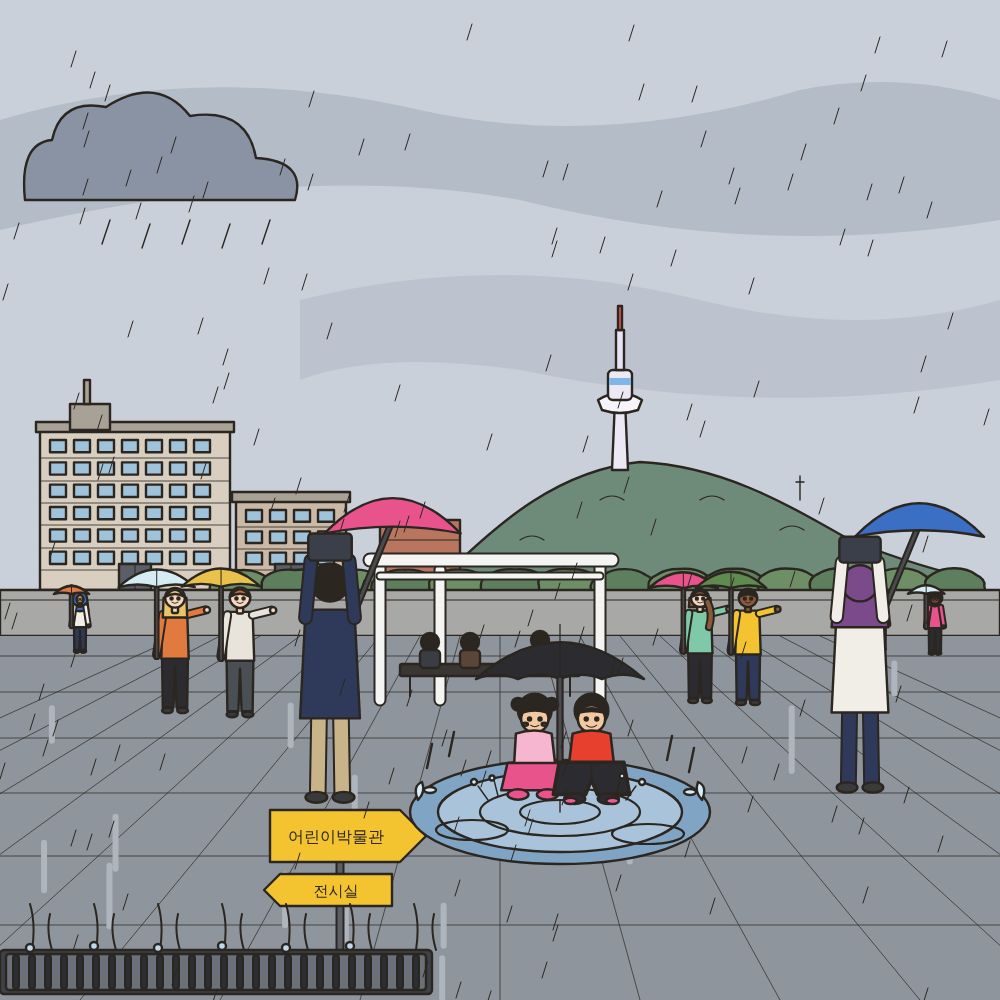
비구름 bigureum rain cloud A dark grey cloud that brings rain. It was raining the day we went, too.
남산타워 namsan tawo N Seoul Tower The tower on top of Namsan — we could see it in the distance from the museum’s outdoor plaza.
쉼터 swimteo rest shelter A roofed spot with benches for a short rest — handy for staying dry in the rain.
표지판 pyojipan signpost A sign pointing the way. Bright yellow signs lead to the Children’s Museum.
우산 usan umbrella Keeps the rain off. On our rainy day, the kids crouched together under one umbrella.
반바지 banbaji shorts Short pants above the knee. On our summer visit our son wore a red T-shirt and black shorts.
물웅덩이 mul ungdeongi puddle Rainwater pooled on the ground — the stone plaza was dotted with them.
배수로 baesuro drain A channel that carries rainwater away through slots in a metal grate.

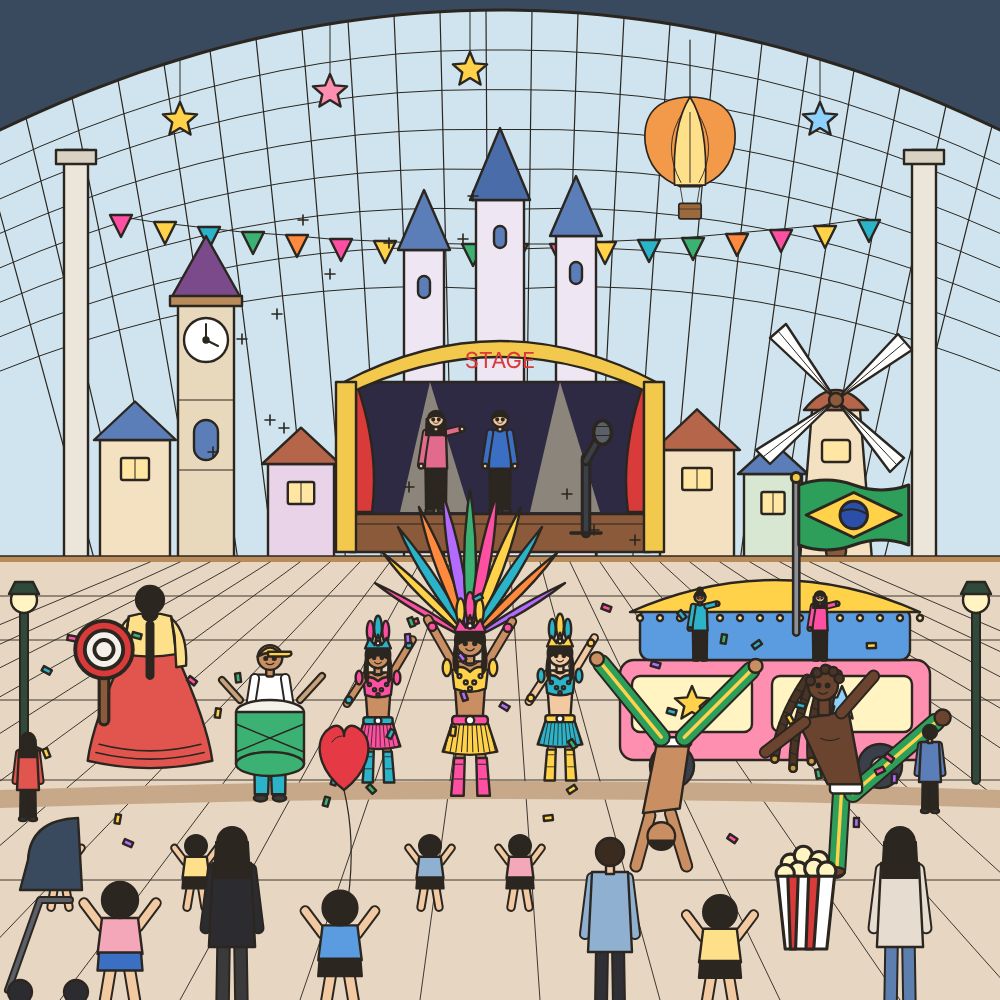
Lotte World – Samba Parade · 롯데월드 - 삼바 퍼레이드

KoreanPronunciationMeaningAbout
퍼레이드카 peoreideuka parade float A decorated vehicle that rolls slowly along with the music — the dancers on top wave to the crowd.
깃털 gitteol feathers The huge, colorful feather piece samba dancers wear. Lotte World has samba shows in summer, and that's when our family likes to go.
소고 sogo sogo (small hand drum) A small Korean drum with a handle. Dancers in hanbok tap it as they spin and dance.
드럼 deureom drum A big drum slung over the shoulder — its boom-boom starts the samba beat.
무대 mudae stage Where the singing and dancing shows happen. Go early and grab a seat before the show starts.
열기구 yeolgigu hot-air balloon A giant balloon that floats on hot air, with a basket for riders. Decorative ones hang from the glass dome ceiling.
풍차 pungcha windmill A building with sails that turn in the wind — there's a storybook-style one by the plaza.
시계탑 sigyetap clock tower A tall tower with a big clock on top — a handy meeting spot.
브라질 국기 beurajil gukgi Brazilian flag Green with a yellow diamond and a blue circle. Samba comes from Brazil, and you can spot its flag at Lotte World's summer samba show.
무술 musul martial arts (capoeira) Fighting skills using the body. Capoeira, a Brazilian martial art, mixes handstands and spinning kicks to music, almost like dancing — you can see it in Lotte World's samba parade.

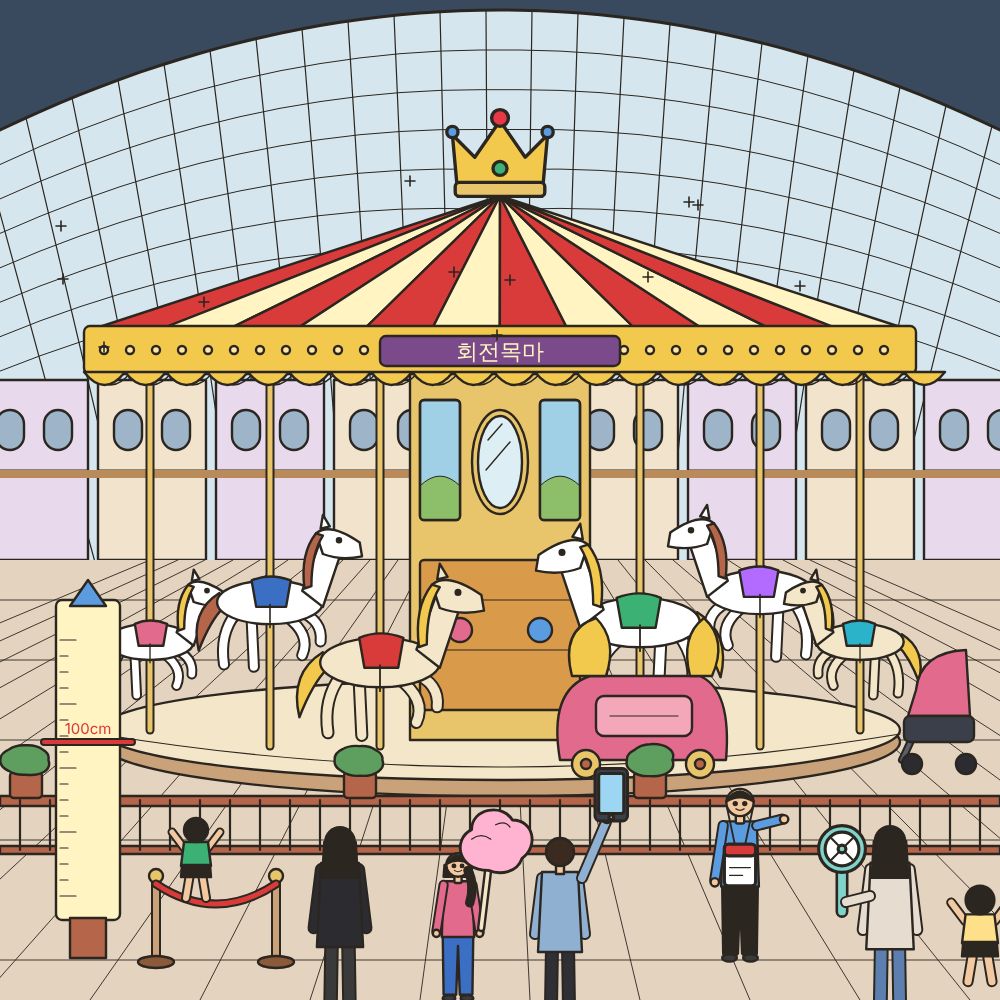
Lotte World – Carousel · 롯데월드 - 회전목마

KoreanPronunciationMeaningAbout
마차 macha carriage A horse-drawn carriage. On the carousel, kids or grown-ups who'd rather not ride a horse sit here.
왕관 wanggwan crown The gold crown a king wears — it tops the carousel roof.
거울 geoul mirror Glass that shows your reflection — the carousel's center column is lined with sparkly mirrors.
키재기 kijaegi height chart A measuring board — every ride has a height limit, so check before you line up.
대기줄 daegijul queue rope The waiting line and the rope that guides it. With kids, skip the urge to ride everything and take it easy.
휴대폰 hyudaepon cell phone A phone you carry around — parents snap photos as their kids ride by.
이용권 iyonggwon park pass Your ticket into the park and its rides. Some people wear their annual pass around their neck.
솜사탕 somsatang cotton candy Sugar spun into fine threads and wound up fluffy like cotton.
손선풍기 sonseonpunggi handheld fan A little handheld fan. Even indoors, Lotte World gets hot in summer — don't forget one.
유모차 yumocha stroller A stroller for babies and little kids — park it in the marked spot while you ride.

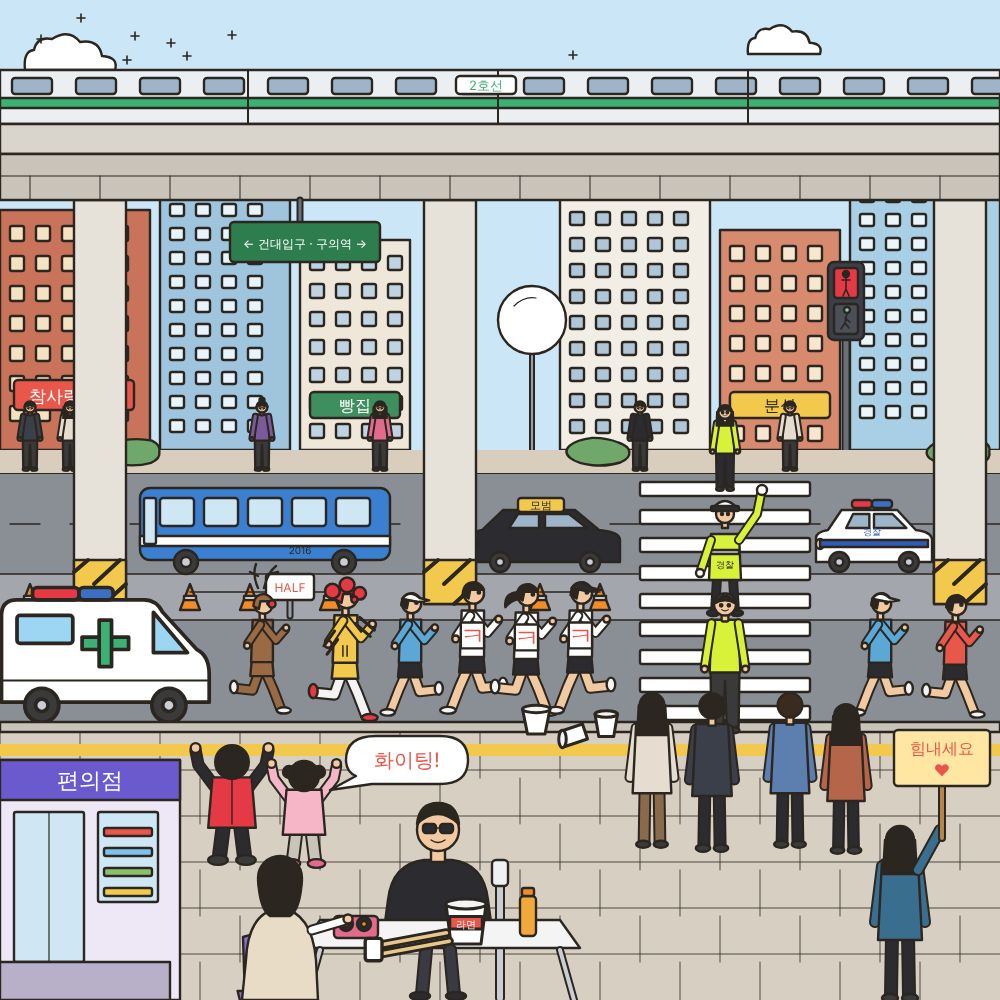
Seoul Marathon – Cheering Spot · 서울 마라톤 - 응원 명당

KoreanPronunciationMeaningAbout
광대 gwangdae clown Someone who makes people laugh. At the marathon, one runner ran in a yellow-and-red clown outfit.
ㅋㅋㅋ kkk LOL (ㅋㅋㅋ) Laughter written with just the letter ‘ㅋ’, like “lol”. Three friends ran side by side in T-shirts printed with ‘ㅋ’.
교통경찰 gyotong gyeongchal traffic police officer Police who direct cars and people. On marathon day, they used hand signals to help people cross.
횡단보도 hoengdan bodo crosswalk White stripes for crossing the street. On marathon day, people crossed in two steps, stopping in the middle.
모범택시 mobeom taeksi deluxe taxi A black premium taxi that costs more than a regular one. On marathon day, the drivers helped people cross too.
구급차 gugeupcha ambulance Takes sick or hurt people to hospital. In a marathon it follows slowly behind the runners.
종이컵 jongi keop paper cup A cup made of paper. Lots of cups that runners tossed after drinking lay by the road.
손팻말 sonpaenmal hand-held sign A sign you hold up and wave, with cheering words like “You can do it!”.
나무젓가락 namu jeotgarak disposable chopsticks Wooden chopsticks you use once. You get them when you buy cup noodles at a store.
컵라면 keop ramyeon cup noodles Noodles you just add hot water to. On marathon day, the family ate them at the table outside the store while cheering.

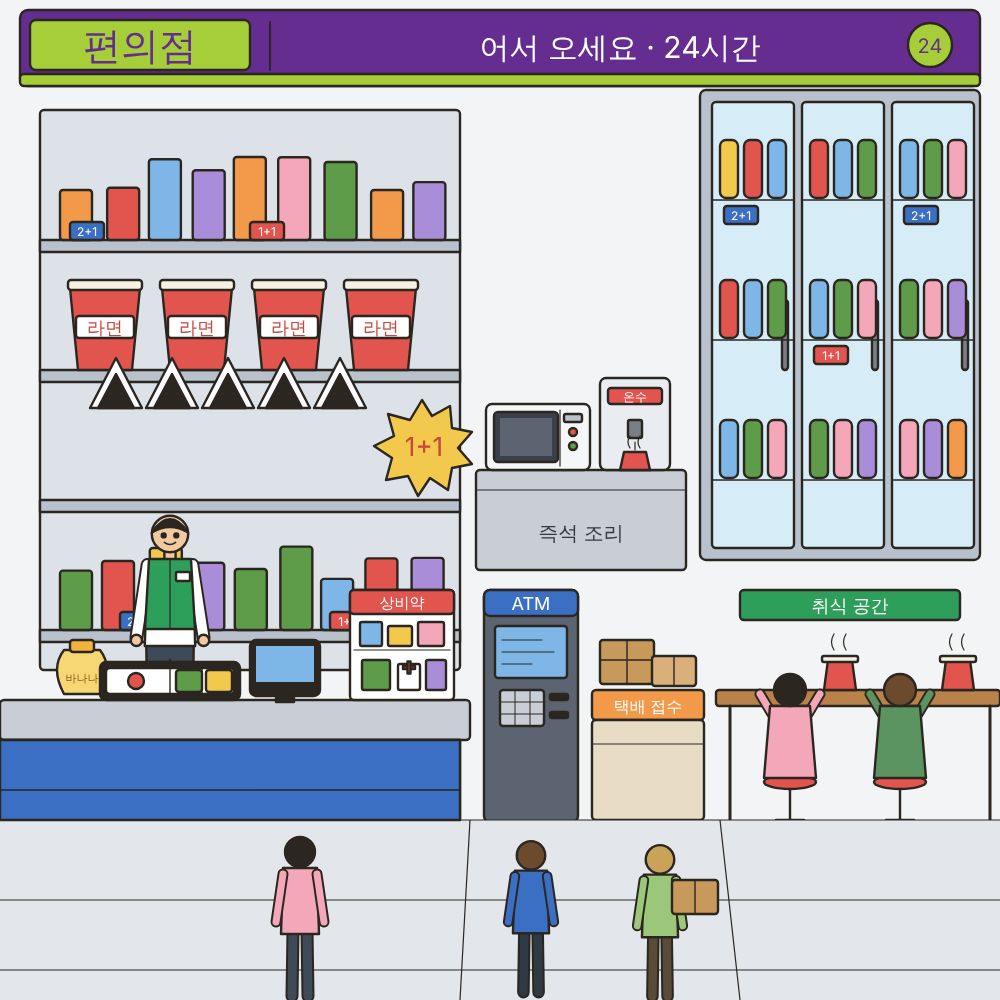
Convenience Store · 편의점

KoreanPronunciationMeaningAbout
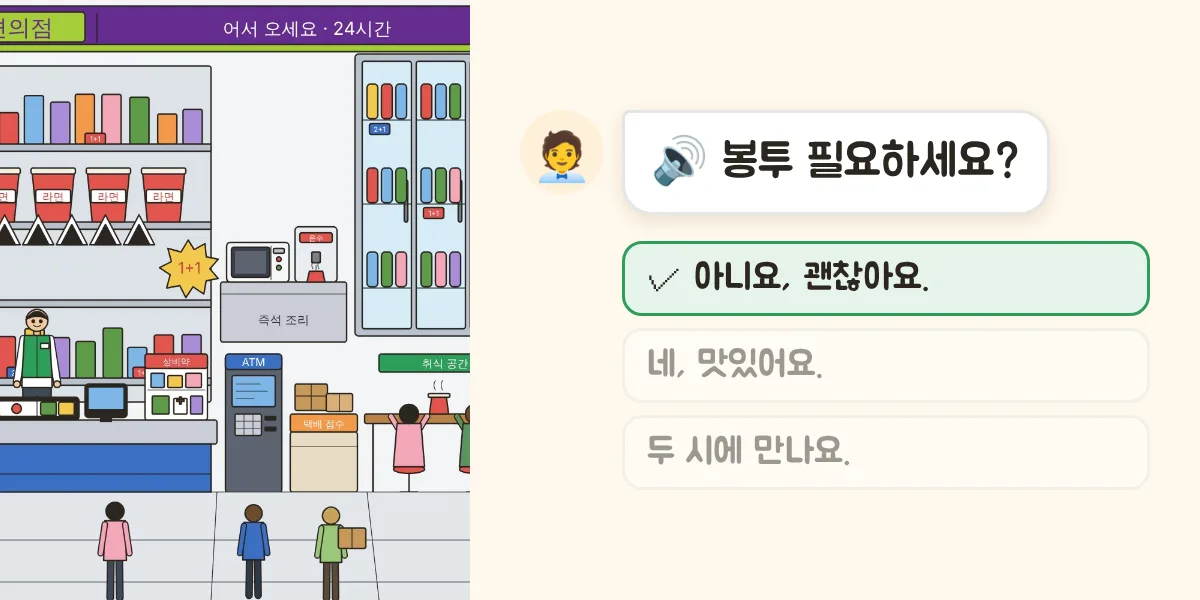
삼각김밥 samgak gimbap triangle rice ball Triangle-shaped rice wrapped in seaweed. Pull the wrapper tabs in order: 1, 2, 3.
바나나우유 banana uyu banana milk Banana-flavored milk in a little jar-shaped bottle — a Korean favorite.
컵라면 keop ramyeon cup noodles Cup noodles. Stores have hot water so you can eat them right there.
도시락 dosirak lunch box A boxed meal with rice and side dishes in compartments.
원 플러스 원 won peulleoseu won buy one get one free “1+1” means buy one, get one free — look for these stickers!
점원 jeomwon store clerk Someone who works at the store. Convenience store clerks ring you up and also help you send parcels.
전자레인지 jeonja reinji microwave A machine for heating food. In Korean convenience stores you can heat what you buy and eat it right there.
택배 taekbae parcel delivery A parcel service. You can drop off a box at a Korean convenience store and it gets delivered far away.
현금인출기 hyeongeum inchulgi ATM A machine for taking out cash with your card — also just called ATM. Many convenience stores have one, open all night.
상비약 sangbiyak household medicine Household medicine for small emergencies, like cold medicine or painkillers. Korean convenience stores sell a small set of approved ones.

Seoul Subway · 지하철

KoreanPronunciationMeaningAbout
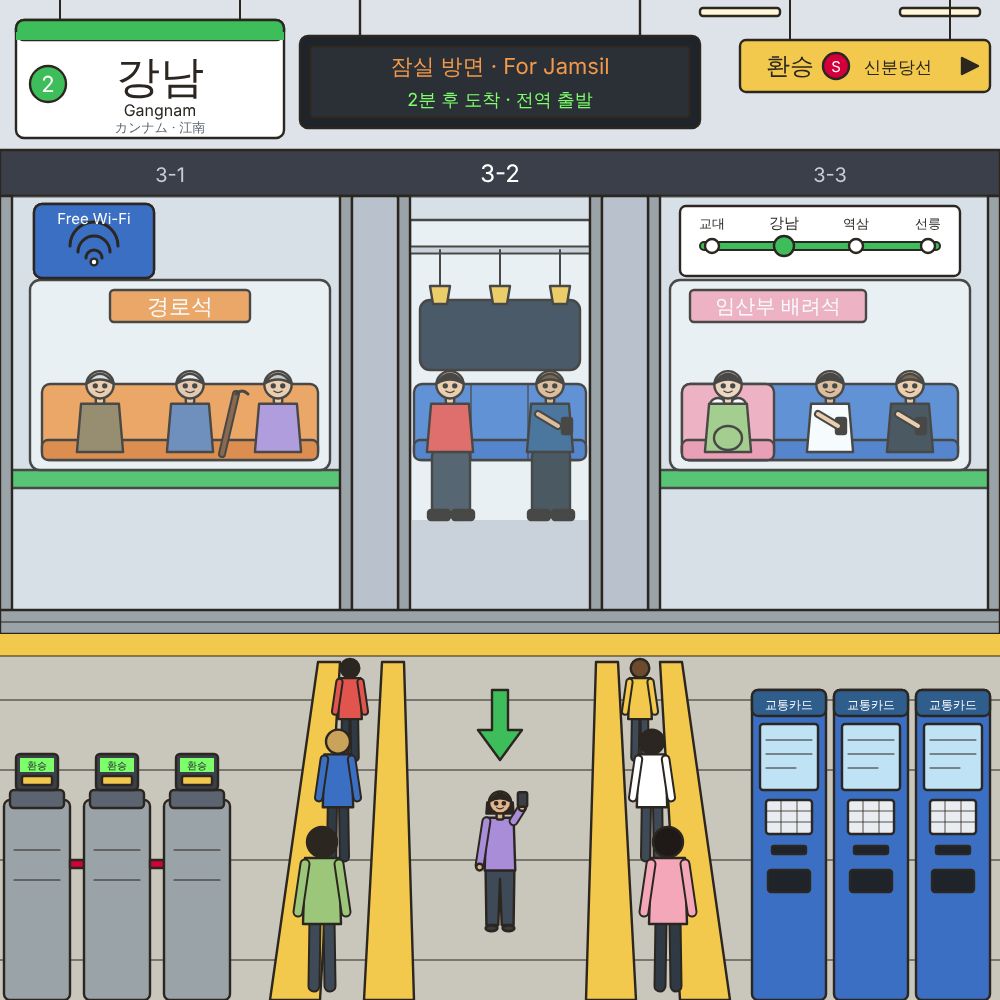
행선안내게시기 haengseon annae gesigi arrival display board An electronic board showing where the next train goes and how many minutes until it arrives. Every platform in Seoul has one.
스크린도어 seukeurin doeo platform screen doors Glass doors between the platform and the tracks. They open only with the train doors — Seoul has them at every station.
경로석 gyeongno seok seats for seniors Seats saved for older people at the end of each car. Even when empty, younger riders leave them free.
임산부 배려석 imsanbu baeryeoseok seat for pregnant women The pink seat kept free for pregnant women.
와이파이 waipai Wi-Fi Wireless internet. In the Seoul subway it works underground, even inside moving trains.
개찰구 gaechalgu fare gate The gate you tap your transit card on. With a Korean transit card, transfers between subway and bus are discounted.
환승 hwanseung transfer Changing to another line or a bus. Pay with a transit card and the transfer is discounted or free.
줄서기 julseogi lining up People line up on both sides of the door along the floor markings. Let people off first, then get on.
노선도 noseondo route map Route map showing the stations in order. Line 2 is green.
발매기 balmaegi ticket machine A machine to buy or top up a transit card. It has English, Japanese and Chinese screens, so visitors can use it easily.

Korean BBQ Restaurant · 돼지갈비집

KoreanPronunciationMeaningAbout
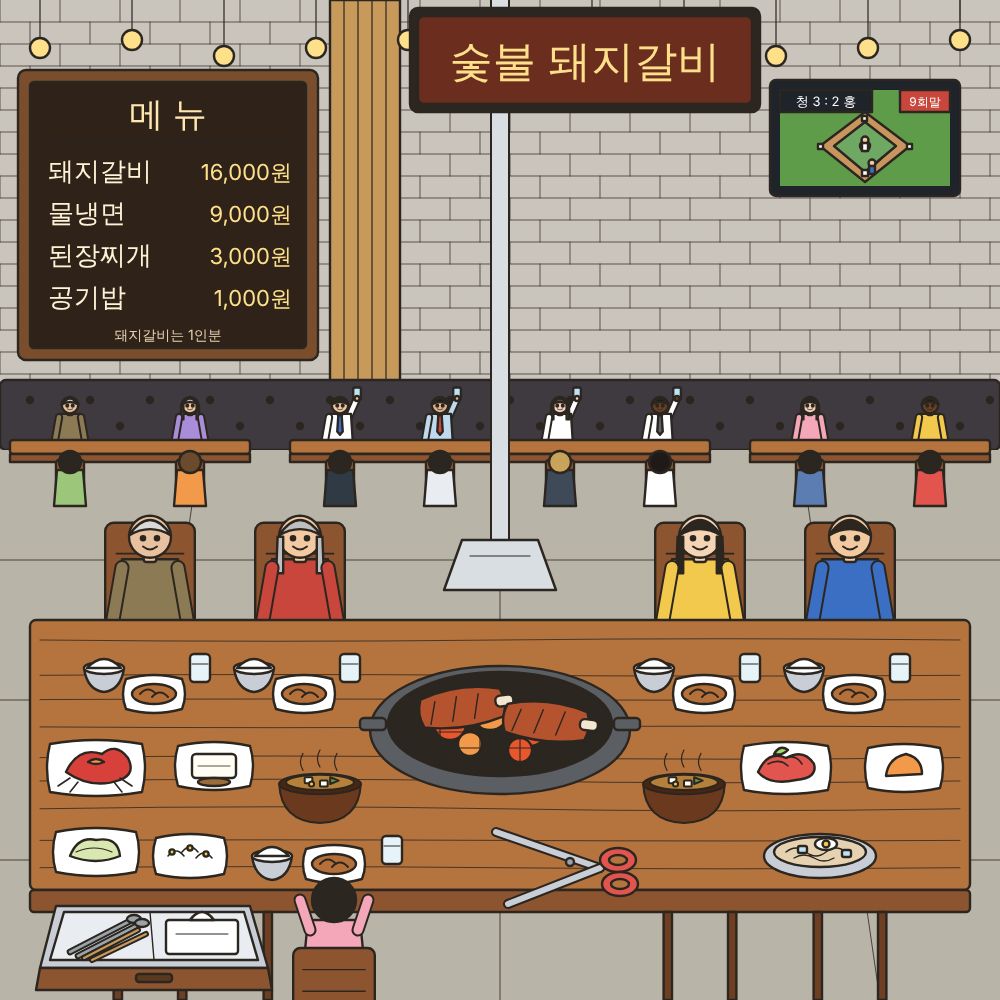
돼지갈비 dwaeji galbi marinated pork ribs Pork ribs marinated in a sweet soy sauce. Dwaeji = pig, galbi = ribs.
숯불 sutbul charcoal fire A fire of glowing charcoal. Pork ribs grilled over charcoal pick up a smoky flavor that makes them extra tasty.
양념게장 yangnyeom gejang spicy marinated crab Raw crab tossed in a spicy sauce. It makes you eat so much rice that Koreans call it a “rice thief”.
순두부 sundubu soft tofu Extra-soft tofu, scooped before it sets. A splash of soy sauce makes it a mild bite between ribs.
양파조림 yangpa jorim onions in soy sauce Sliced onions soaking in a soy sauce dip. Dunk the grilled meat in it for a sweet-salty bite.
김치 gimchi kimchi Cabbage fermented with chili and seasonings — Korea’s signature side dish. Every restaurant brings it first.
된장찌개 doenjang jjigae soybean paste stew A stew of soybean paste, tofu and vegetables, served bubbling in a clay pot — the classic way to finish a BBQ meal.
냉면 naengmyeon cold noodles Thin noodles in an icy broth. Eating them after grilled meat feels so refreshing.
공기밥 gonggibap bowl of rice Rice served in a lidded steel bowl. Pork ribs with rice makes a hearty, filling meal.
수저통 sujeotong cutlery drawer In Korean restaurants the spoons, chopsticks and napkins hide in a drawer on the side of the table. Can’t find them? Pull open the drawer!

Pork Belly BBQ · 삼겹살집

KoreanPronunciationMeaningAbout
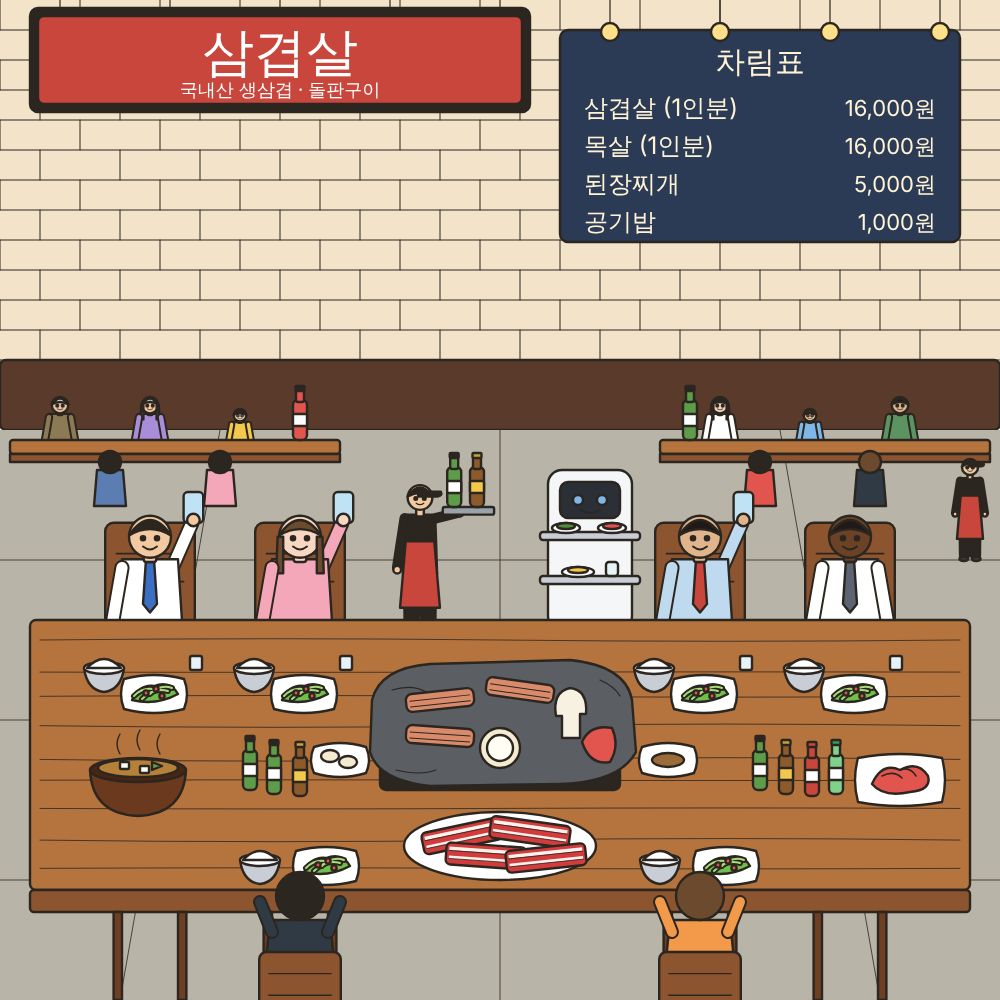
삼겹살 samgyeopsal pork belly Pork belly. Sam = three, gyeop = layers: three layers of meat and fat.
돌판 dolpan stone grill plate A flat stone slab for grilling. The stone spreads the heat evenly, so the pork belly turns crisp outside and juicy inside.
파절이 pajeori green onion salad Thinly sliced green onions tossed in a tangy, spicy dressing. Everyone gets their own plate to eat with the grilled pork.
공기밥 gonggibap bowl of rice Rice in a lidded steel bowl. With grilled pork, it makes a hearty meal.
소주 soju soju A Korean liquor in a green bottle — for grown-ups only. People pour it into small glasses and toast.
맥주 maekju beer Beer in a brown bottle — grown-ups only. At BBQ places some people mix it with soju.
음료수 eumnyosu soft drink Drinks like cola and cider. Kids and grown-ups alike enjoy them with grilled meat.
된장찌개 doenjang jjigae soybean paste stew Soybean paste stew with tofu, served bubbling in an earthen pot (ttukbaegi).
김치 gimchi kimchi Fermented spicy cabbage. At pork belly restaurants it is delicious grilled right next to the meat.
서빙 로봇 seobing robot serving robot A robot that carries food to your table. In many Korean restaurants it even brings your side dish refills.

Snack Bar (Bunsik) · 분식집

KoreanPronunciationMeaningAbout
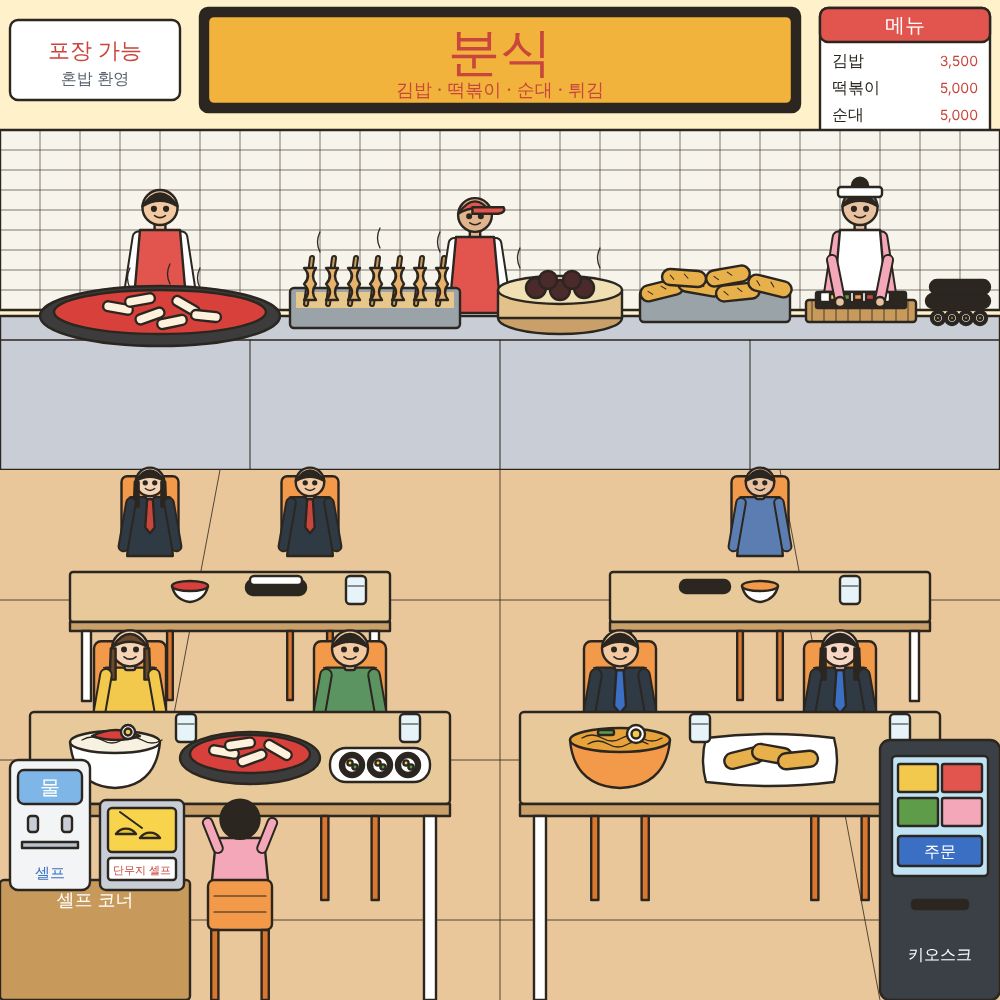
키오스크 kioseukeu ordering kiosk A touch-screen kiosk for ordering and paying.
정수기 jeongsugi water dispenser Water dispenser. “Self” (셀프) means help yourself — water is free.
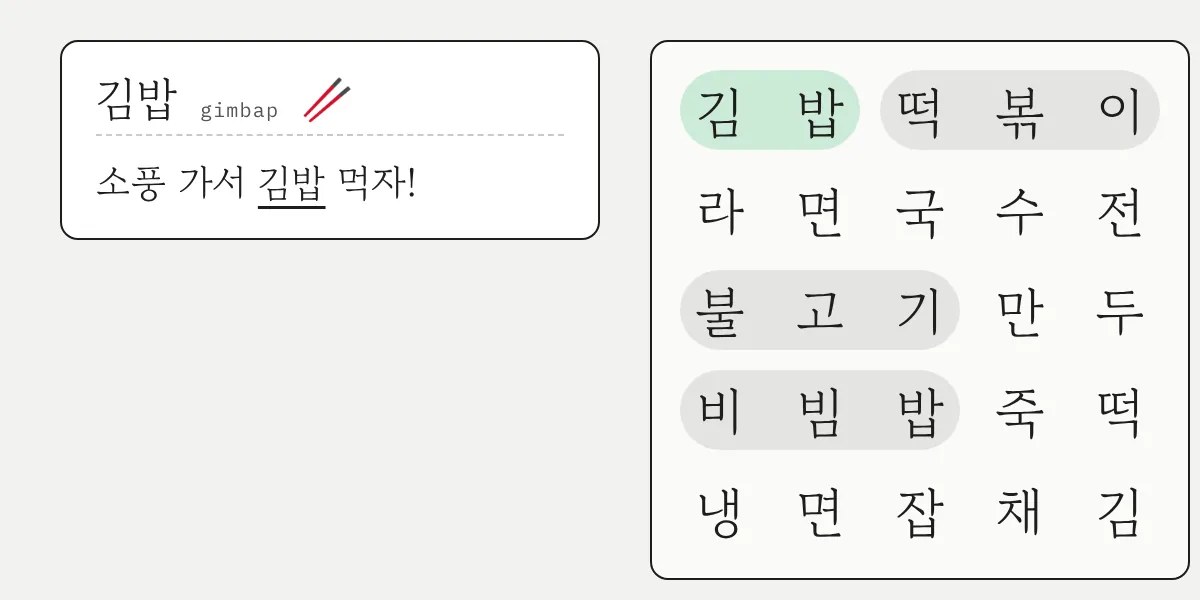
김밥 gimbap gimbap Rice and fillings rolled in seaweed (gim) and sliced.
떡볶이 tteokbokki spicy rice cakes Rice cakes in sweet-spicy chili sauce — the king of bunsik.
순대 sundae Korean blood sausage Korean sausage stuffed with glass noodles, dipped in salt. (Not the ice-cream sundae!)
튀김 twigim fried snacks Battered and deep-fried vegetables, squid or shrimp — great dipped in tteokbokki sauce.
단무지 danmuji pickled radish Sweet yellow pickled radish served on the side.
라면 ramyeon ramyeon noodles Curly instant noodles in a spicy broth. Snack bars cook them with egg and green onion.
쫄면 jjolmyeon chewy spicy noodles Extra-chewy noodles tossed in a sweet, sour and spicy sauce, topped with vegetables and a boiled egg.
어묵 eomuk fish cake Ground fish cake. Skewered and simmered in broth, it is a snack bar favorite — and the hot broth is free to sip.

Korean-Chinese Restaurant · 중국집

KoreanPronunciationMeaningAbout
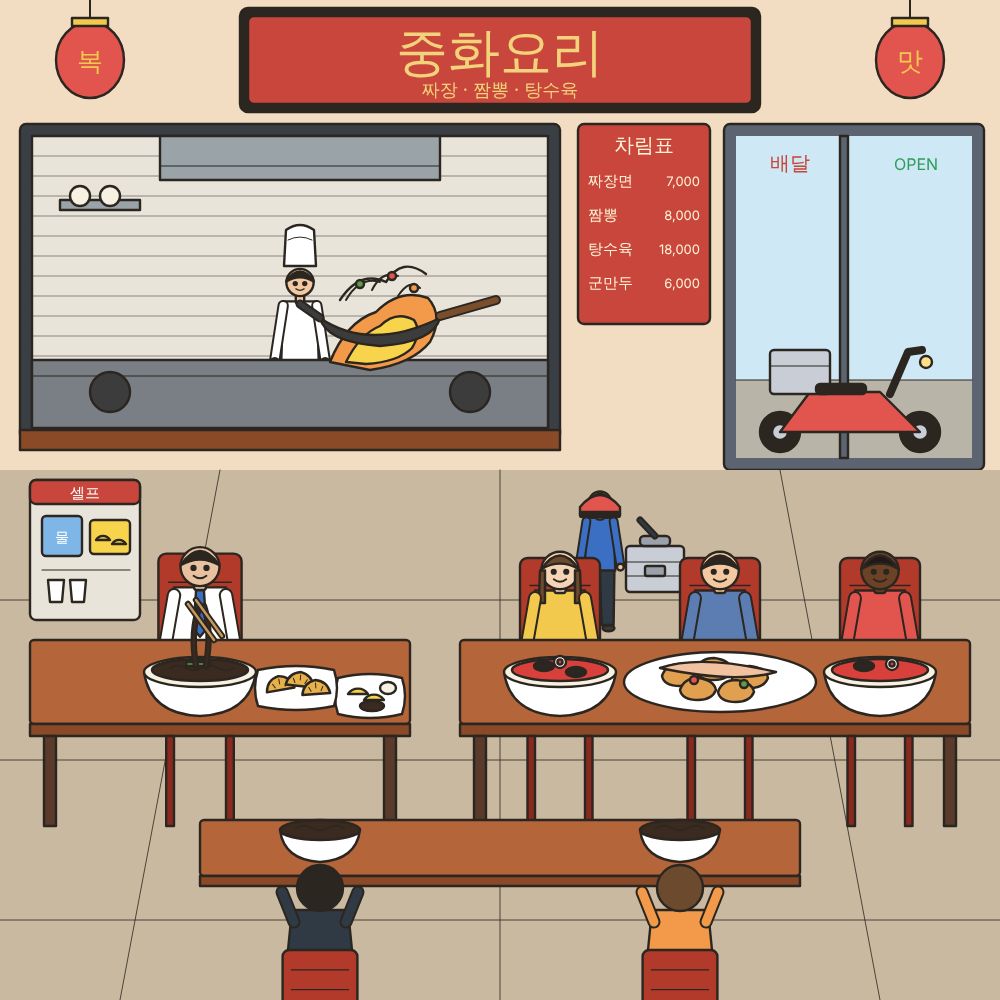
차림표 charimpyo menu Charimpyo — another Korean word for menu.
짜장면 jjajangmyeon black bean noodles Noodles in black bean sauce — the classic meal on moving day.
짬뽕 jjamppong spicy seafood noodle soup Spicy red seafood noodle soup.
탕수육 tangsuyuk sweet and sour pork Crispy sweet-and-sour pork. Koreans love to debate: pour the sauce (bumeok) or dip (jjikmeok)?
군만두 gunmandu fried dumplings Pan-fried dumplings, often given free as “service” (seobiseu).
춘장 chunjang black bean paste Black bean paste — the base of jjajang sauce, also served as a dip.
철가방 cheolgabang metal delivery box The metal delivery box — the symbol of Korean-Chinese food delivery.
단무지 danmuji yellow pickled radish Sweet and tangy yellow pickled radish. It always comes with Korean-Chinese food and goes great with jjajangmyeon.
웍 wok wok A big round-bottomed pan. When the chef tosses it over roaring flames, it gives the food a smoky “fire flavor” Koreans call bulmat.
오토바이 otobai motorbike The delivery motorbike. In Korea, jjajangmyeon zooms by motorbike to homes — and even to parks.

Lamb Skewer Restaurant – Rotating Grill · 양꼬치집 - 회전 그릴

KoreanPronunciationMeaningAbout
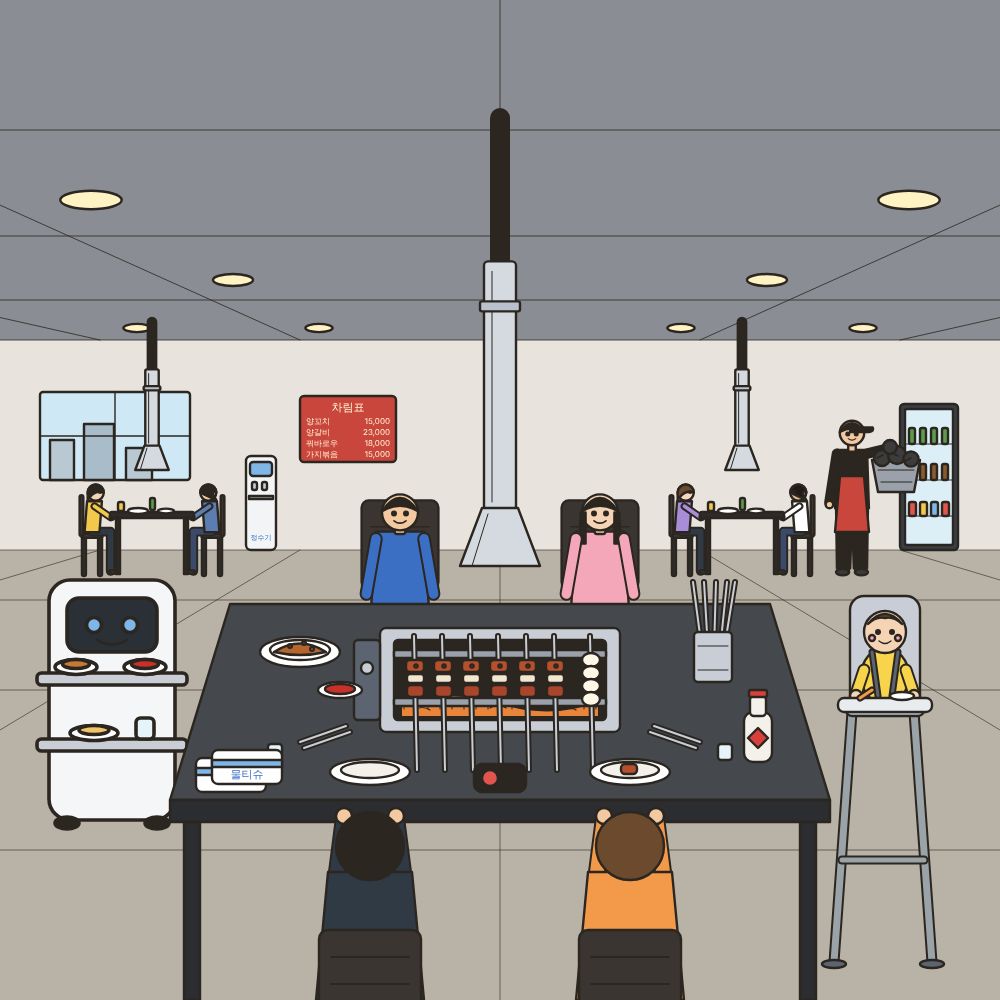
양꼬치 yanggochi lamb skewer Lamb threaded on a skewer and grilled over charcoal. It comes from northeast China and is hugely popular in Korea.
숯 sut charcoal Black fuel made by burning wood. It stays hot for a long time with almost no flame — perfect for grilling. Very hot, so don’t touch.
쯔란 jjeuran cumin spice dip A dry spice mix for dipping lamb skewers — cumin with chili powder, sesame and more. Say “Jjeuran deo juseyo” for more.
마늘꼬치 maneul kkochi garlic skewer Whole garlic cloves on a skewer. Grilled, they turn sweet and soft.
연통 yeontong exhaust duct A silver pipe hanging from the ceiling over the table. It sucks up the smoke from the grilling meat.
꼬치통 kkochi tong skewer bucket A container for the empty skewers. The tips are sharp, so be careful.
고량주 goryangju kaoliang (sorghum liquor) A Chinese liquor made from sorghum. It’s very strong, so it’s drunk from tiny glasses. Adults only.
물티슈 multisyu wet wipe A damp tissue for wiping your hands. Many Korean restaurants put them right on the table.
호출벨 hochul bel call button Press it and a server comes over. It’s common on Korean restaurant tables — ring, then order.
앞접시 apjeopsi side plate (individual plate) A small plate for taking food from the big shared dish. Say “Apjeopsi hana deo juseyo” to ask for one more.

Lamb Skewer Restaurant – Dishes & Sides · 양꼬치집 - 요리와 반찬

KoreanPronunciationMeaningAbout
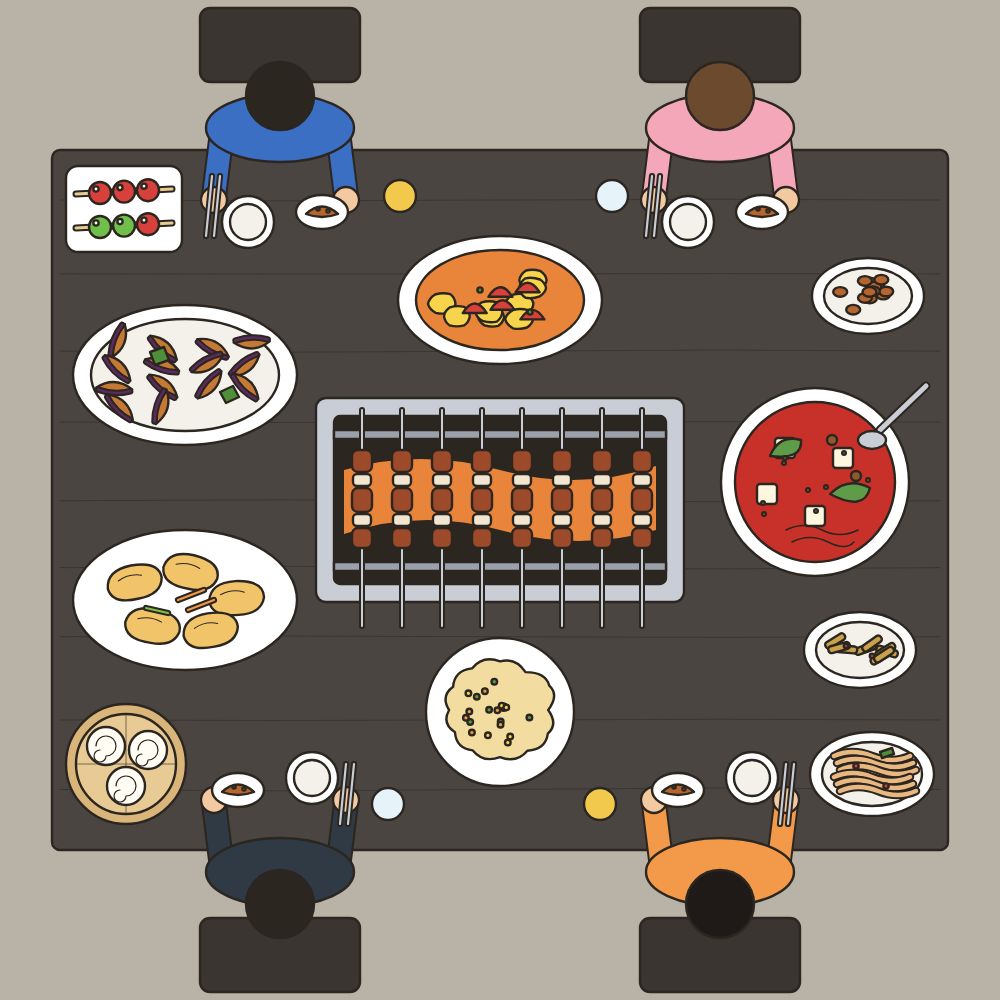
가지볶음 gaji bokkeum stir-fried eggplant Eggplant fried until crisp and coated in a sweet-salty sauce. Crunchy outside, soft inside — a favorite at lamb skewer places.
토마토달걀볶음 tomato dalgyal bokkeum tomato and egg stir-fry A Chinese home-style dish of tomatoes and eggs stir-fried together. Sweet and tangy — great with rice.
건두부무침 geondubu muchim spicy dried tofu salad Thin dried tofu cut into noodle-like strips and tossed in a spicy dressing. It’s a side dish.
땅콩 ttangkong peanuts Many lamb skewer places give roasted peanuts as a free side. Be careful if you have a peanut allergy.
짜사이 jjasai zha cai (pickled mustard stem) A salty Chinese pickle made from mustard stems. It comes as a free side dish.
꿔바로우 kkwobarou guo bao rou (crispy sweet and sour pork) Pork coated in glutinous rice batter, fried in wide pieces and glazed with sweet and sour sauce. Like Korean tangsuyuk, but chewier.
마라탕 maratang malatang (mala soup) A Chinese broth so spicy it numbs your tongue, filled with vegetables, noodles and meat. Hugely popular with Korean teens. You can say “덜 맵게 해 주세요” (less spicy, please).
꽃빵 kkotppang steamed flower bun (huajuan) A steamed bun rolled up like a flower. It tastes plain, so people eat it with spicy dishes.
탕후루 tanghuru tanghulu (candied fruit skewer) Fruit on a stick coated in hardened sugar syrup. It crunches when you bite! It became a huge trend in Korea around 2023.
볶음밥 bokkeumbap fried rice Rice stir-fried in oil with egg and vegetables. People often order it to finish the meal.

Factory Floor · 공장 작업장

KoreanPronunciationMeaningAbout
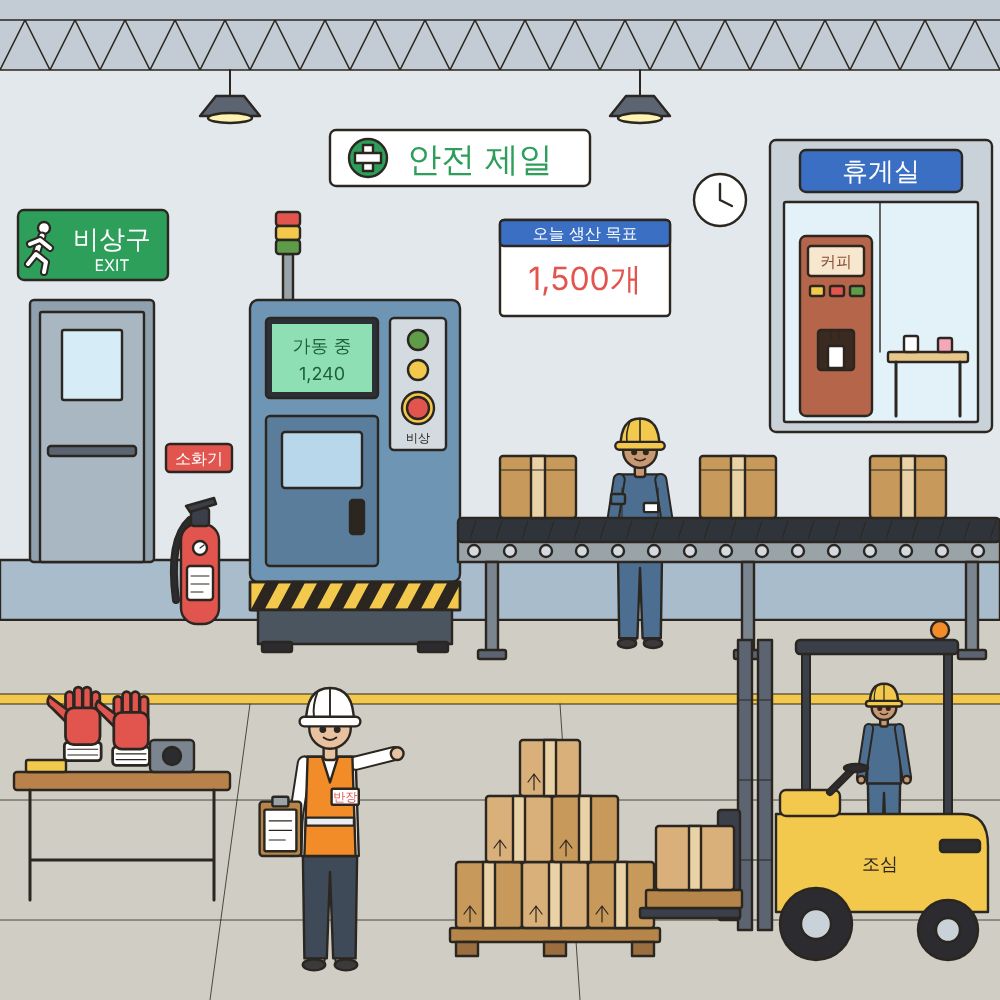
컨베이어 벨트 keonbeieo belteu conveyor belt A long moving belt that carries products. Never put your hand in while it runs — to stop it, press the emergency stop button.
지게차 jigecha forklift A truck that lifts and moves pallets. Only licensed people drive it — keep well away when one passes.
작업복 jageopbok work clothes Clothes you wear for work. Keep the sleeves neat so they can’t get caught in a machine. “Please change into your work clothes.”
반장님 banjangnim team leader (foreman) The leader of your work team (-nim is a polite title). When unsure, ask: “Banjangnim, how do I do this?”
소화기 sohwagi fire extinguisher The red can that puts out fires. Pull the safety pin, aim the hose at the fire and squeeze the handle.
비상구 bisanggu emergency exit The door to get out in a fire or emergency. Follow the green sign — and never block it with boxes.
장갑 janggap work gloves Gloves that protect your hands — cotton ones with a red rubber-coated palm are common. Near some spinning machines, though, you may be told to take them off.
박스 bakseu box A cardboard box (also called sangja). “Please move this box over there.” Bend your knees to lift heavy ones.
기계 gigye machine The machine that makes the products. If it breaks or sounds strange, don’t fix it yourself — tell your team leader. The red button is the emergency stop.
휴게실 hyugesil break room The room where you rest on breaks, often with a coffee machine and a water dispenser. “I’ll take a short break in the break room.”

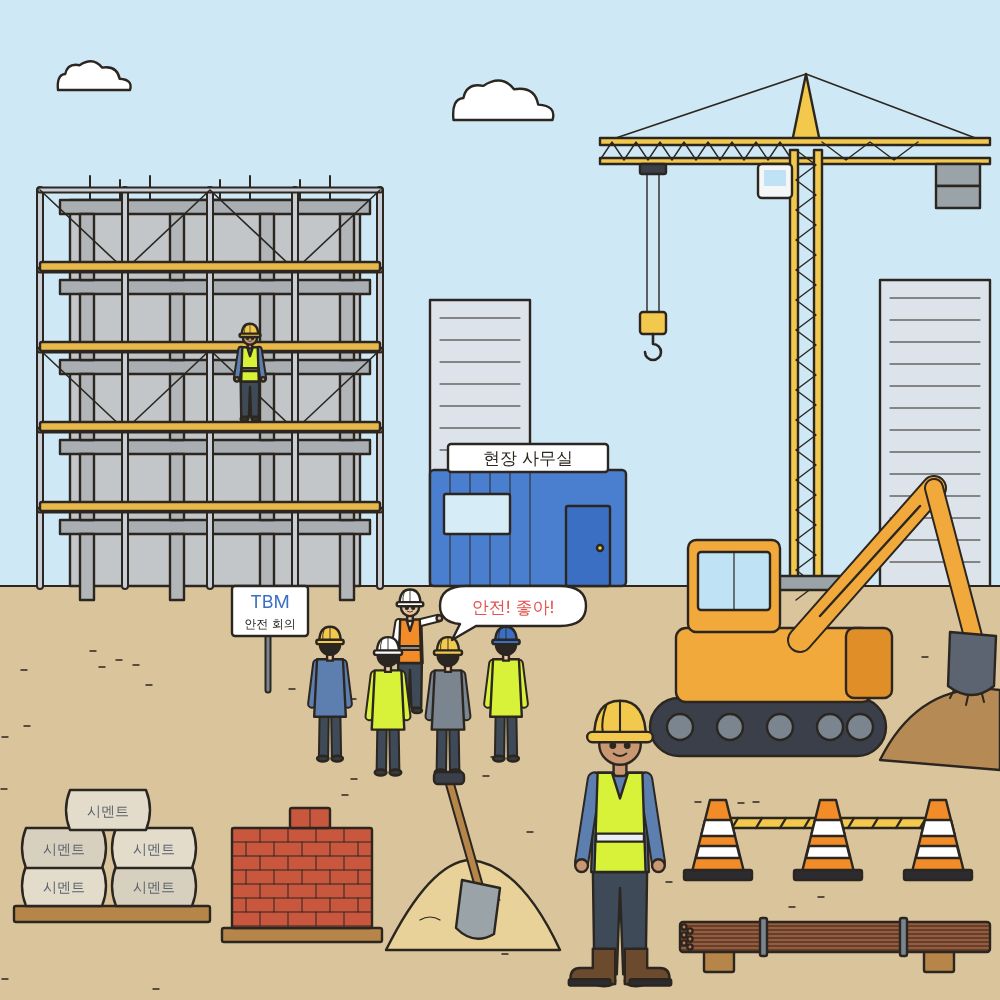
Construction Site · 건설 현장

KoreanPronunciationMeaningAbout
크레인 keurein tower crane The machine that lifts heavy materials up high. Never walk under a load the crane is lifting.
굴착기 gulchakgi excavator Heavy machinery that digs the ground — on site it’s often called “pokeullein”. Don’t stand next to it while it swings around.
비계 bigye scaffolding Pipes and planks put up so you can work high up. On scaffolding, always clip on your safety harness.
안전모 anjeonmo hard hat The helmet that protects your head. Always wear it on site and fasten the chin strap. “Put on your hard hat!”
안전화 anjeonhwa safety boots Shoes with a hard toe cap. They protect your feet from nails and heavy objects.
벽돌 byeokdol brick Rectangular blocks for building walls, laid one by one with mortar. You count them with jang: “han jang, du jang”.
시멘트 simenteu cement (bags) A powder mixed with water and sand to lay bricks or make concrete. The bags are heavy — carry them in pairs or mind your back.
철근 cheolgeun rebar (steel bars) Steel bars set inside concrete to make the building strong. They are long and heavy — watch both ends when you carry them.
삽 sap shovel A tool for scooping soil or sand. “Please bring me the shovel” is “Sap jom gajyeodajuseyo.”
라바콘 rabakon traffic cone Orange cones that mark a danger or work zone. Don’t go inside an area blocked off with cones.

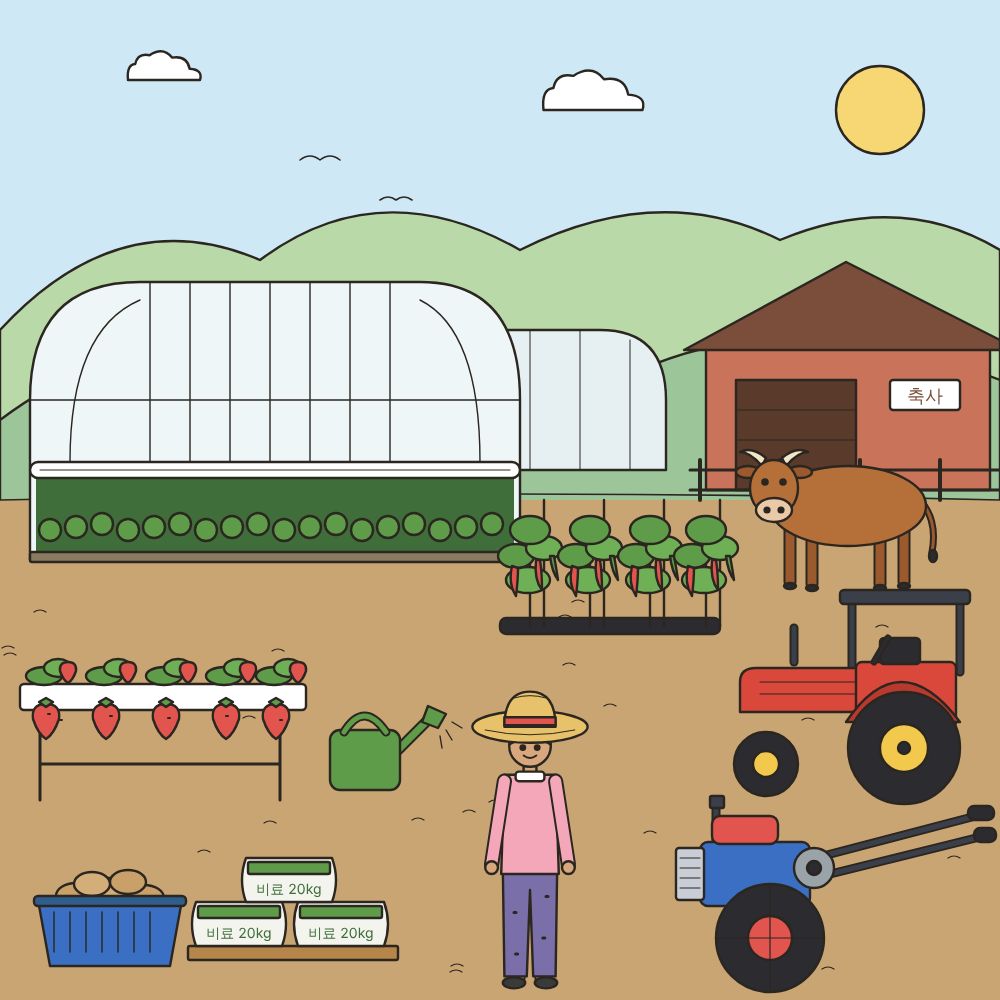
Farm Greenhouse · 농장 비닐하우스

KoreanPronunciationMeaningAbout
비닐하우스 binil hauseu plastic greenhouse A greenhouse covered with plastic film for growing vegetables and fruit, even in winter. It gets very hot at midday — drink water often.
고추 gochu chili pepper The spicy vegetable used in so much Korean food. When it turns red it’s picked and dried to make chili powder.
딸기 ttalgi strawberry A sweet red fruit. In Korea it’s mostly grown in greenhouses from winter to spring. Pick gently.
물뿌리개 mulppurigae watering can A can for watering plants — mul means water. For big fields you use a hose.
트랙터 teuraekteo tractor A big farm machine for plowing and pulling heavy loads. Riding on the back is dangerous.
비료 biryo fertilizer Nutrients you give the soil so plants grow well. It comes in bags — wash your hands after handling it.
바구니 baguni basket A container for harvested vegetables and fruit — this one is full of potatoes. “When this basket is full, put it over there.”
밀짚모자 miljip moja straw hat A wide-brimmed hat that keeps the sun off — a must for summer field work.
경운기 gyeongungi power tiller (walking tractor) A small farm machine you steer by two long handles. It tills the field or pulls a cart — a common sight in the Korean countryside.
소 so cow Cattle raised in the barn — Korean native cattle are called hanu. Don’t stand right behind a cow; it may kick.

Frequently asked questions

Show all 48 questions

Han River Park

Which Han River Park should I go to?

There are many parks along the Han River. Visitors usually pick Yeouido Hangang Park (Yeouinaru Station) or Banpo Hangang Park, home of the rainbow fountain on Banpo Bridge. Entry is free.

How do I eat ramyeon by the Han River?

Buy instant noodles at a park convenience store, put them in a paper bowl and cook them on the store’s instant ramyeon machine. That is the famous “Hangang ramyeon.”

More questions about Han River Park (7) →

Bukchon Hanok Village

How do I get to Bukchon Hanok Village?

Take subway Line 3 to Anguk Station and walk. It sits on the hill between Gyeongbokgung and Changdeokgung, so it pairs well with both palaces.

Is there an entrance fee?

No. Bukchon is a real neighborhood where people live, so you can walk its alleys freely.

More questions about Bukchon Hanok Village (7) →

Gyeongbokgung Palace

How do I get to Gyeongbokgung Palace?

Gyeongbokgung Station on subway Line 3 connects right to the palace, and you can also walk from Gwanghwamun Station on Line 5. You enter through Gwanghwamun, the main gate, past Gwanghwamun Square.

Is it ever closed?

Gyeongbokgung is closed every Tuesday. Opening hours change with the season, so check the official site.

More questions about Gyeongbokgung Palace (7) →

Myeongdong Street

How do I get to Myeongdong?

Get off at Myeongdong Station (Line 4) or Euljiro 1-ga Station (Line 2) and you are there. It is also close to the Namsan cable car, so the two make a good pair.

When does the street food start?

Stalls start opening in the late afternoon and are busiest in the evening. There are very few in the morning.

More questions about Myeongdong Street (7) →

Namsan & N Seoul Tower

How do I get up Namsan to N Seoul Tower?

Take the Namsan cable car, the Namsan circulating bus (01A or 01B), or walk. The cable car station is about a 10-minute uphill walk from exit 3 of Myeongdong Station, and the Namsan Oreumi inclined elevator saves part of the climb. Walking up from Myeongdong or Namsan Library takes about 30–40 minutes.

Is the cable car line long?

On weekends and around sunset the wait can be long. Many people take the bus up and walk down.

More questions about Namsan & N Seoul Tower (9) →

Gwangjang Market

How do I get to Gwangjang Market?

It is right next to Jongno 5(o)-ga Station on Line 1, and you can also walk from Euljiro 4(sa)-ga Station on Lines 2 and 5. It is close to Cheonggyecheon Stream, so you can combine it with a walk.

What is Gwangjang Market?

Opened in the early 1900s, it is one of the oldest traditional markets in Seoul. The food alley in the middle serves Korean street food like pancakes, gimbap and noodles, and the upper floors and side streets sell fabric, hanbok and vintage clothes.

More questions about Gwangjang Market (8) →

Amsa-dong Prehistoric Site

What is the Amsa-dong Prehistoric Site?

It is a village site where Neolithic people lived by the Han River about 6,000 years ago. It is one of the places in Korea where the most Neolithic house sites have been found, and it is a designated national historic site.

How do I get there?

It is in Gangdong-gu, Seoul. You can walk from Amsa Station or Amsa History Park Station on subway Line 8. A map app is the easiest way to check bus routes.

More questions about Amsa-dong Prehistoric Site (8) →

Seoul Forest

How do I get to Seoul Forest?

Walk from Seoul Forest Station on the Suin-Bundang Line or Ttukseom Station on Line 2. It sits right next to the Seongsu-dong café streets, so many people visit both together.

Is there an entrance fee?

No, Seoul Forest is a public park that anyone can enter for free. For some facilities or programs inside, check the separate information.

More questions about Seoul Forest (8) →

Seoul Forest – Floor Fountain

Where is the Seoul Forest floor fountain?

It is in a wide plaza inside Seoul Forest. You can walk there from Seoul Forest Station on the Suin-Bundang Line or Ttukseom Station on Line 2, and it is close to the park entrance, so it is easy to find.

When does the floor fountain run?

It usually runs only in the hot summer months, at set times. The season and hours can change every year, so check the official Seoul Forest information.

More questions about Seoul Forest – Floor Fountain (9) →

Seokchon Lake – Cherry Blossom Path

How do I get to Seokchon Lake?

Walk from Jamsil Station on subway Lines 2 and 8. The lake is right next to Lotte World Tower and Lotte World, so it’s easy to find.

When do the cherry blossoms bloom at Seokchon Lake?

Usually in full bloom between late March and early April. The timing changes a little every year, so check the bloom forecast or the Songpa cherry blossom festival info before you go.

More questions about Seokchon Lake – Cherry Blossom Path (8) →

Seokchon Lake – Summer Night Lights

Is Seokchon Lake worth visiting on a summer night?

Yes. It’s cooler than the daytime, and the path lights and their reflections on the water are beautiful, so lots of people come for an evening walk. It’s free and a short walk from Jamsil Station (Lines 2 and 8).

What is that loud noise in the trees?

Cicadas. Korea has huge numbers of cicadas in July and August, and where the lights are bright they can be loud even at night.

More questions about Seokchon Lake – Summer Night Lights (8) →

Lotte World Tower – Christmas Market

Where and when is the Lotte World Tower Christmas Market?

It’s held on the outdoor plaza (World Park) in front of Lotte World Mall, usually from late November to late December. Dates and entry rules (such as reservations) change every year, so check Lotte’s official info.

How do I get there?

Jamsil Station on subway Lines 2 and 8 connects underground to Lotte World Mall. It’s right next to Seokchon Lake, so you can combine it with a lakeside walk.

More questions about Lotte World Tower – Christmas Market (8) →

Hwadam Forest – Pond in the Rain

Do I need a reservation for Hwadam Forest?

Yes. Hwadam Forest (Hwadamsup) is 100% online advance reservation only. Tickets are sold only on the NOL (Nol Universe) app and website, and you need an account. You enter at the time slot you booked. Weekends and the autumn-foliage season sell out early, so book ahead.

How much is the Hwadam Forest admission fee?

As of November 2026 (official website, spring–autumn): adults 11,000 won, seniors and teens 9,000 won, children (24 months to elementary school) 7,000 won, and under 24 months free. The monorail is a separate ticket.

More questions about Hwadam Forest – Pond in the Rain (10) →

Hwadam Forest – Pine Garden & Monorail

How much is the Hwadam Forest monorail?

As of November 2026 (official website): Station 1→2 (about 5 min) adults 5,000 won, children 4,000 won; Station 1→3 (about 10 min) adults 7,000 won, children 6,000 won; the full loop (about 20 min) adults 9,000 won, children 7,000 won. It’s separate from the admission ticket.

How does the monorail run?

It’s a 1,213 m loop that starts at Station 1 by the Moss Garden entrance, passes the top of the hill and comes round to the Bonsai Garden. There are three stations, so you can get off at Station 2 or 3 and walk from there.

More questions about Hwadam Forest – Pine Garden & Monorail (8) →

Konjiam – Luge 360

What are the height limits for the Konjiam Luge?

To ride alone you must be at least 135 cm tall and at least 10 years old (3rd grade). Children 90–134 cm ride together with one adult (two adults or two children can’t share a cart). Children under 90 cm can’t ride.

How much is the Konjiam Luge 360?

As of November 2026 (official website): 1 ride 18,000 won, 2 rides 28,000 won, 3 rides 37,000 won, unlimited pass 69,900 won. A child riding with an adult pays 7,000 won for 1 ride, 13,000 won for 2 and 18,000 won for 3.

More questions about Konjiam – Luge 360 (10) →

Convenience Store

Are Korean convenience stores open 24 hours?

Most are, but some inside buildings or in quiet neighborhoods close at night. The main chains are CU, GS25, 7-Eleven and emart24.

What do “1+1” and “2+1” mean?

Buy one, get one free (1+1) and buy two, get one free (2+1). Pick items from the same promotion and bring them to the counter.

More questions about Convenience Store (9) →

Seoul Subway

How do I ride the Seoul subway?

Tap a transit card such as T-money at the gate and walk through. You can buy and top up transit cards at convenience stores near stations, and single-journey cards are sold at station machines.

Do I pay again when I transfer from the subway to a bus?

If you use a transit card and tap it when you get off, transfers within the time limit are discounted. To change subway lines, just follow the transfer signs without leaving the gates.

More questions about Seoul Subway (8) →

Korean BBQ Restaurant

What is galbi?

Galbi means ribs, and it’s often marinated in a soy-based sauce before grilling. There is beef galbi (so-galbi) and pork galbi (dwaeji-galbi), and also un-marinated saeng-galbi.

Who grills the meat?

It depends on the restaurant. At many places staff come to grill the meat and cut it with scissors; at others you grill it yourself. If you’re not sure, just ask.

More questions about Korean BBQ Restaurant (8) →

Pork Belly BBQ

What is samgyeopsal?

It’s thick-sliced pork belly. The name means “three layers” because you can see layers of meat and fat. It’s usually grilled without marinade and dipped in salted sesame oil or ssamjang.

How do I make a lettuce wrap (ssam)?

Put a piece of meat on lettuce or a perilla leaf, add ssamjang, garlic and scallion salad (pajeori), then eat it in one bite. The trick is to keep it bite-sized.

More questions about Pork Belly BBQ (8) →

Snack Bar (Bunsik)

What is a bunsik shop?

It’s a snack bar that sells quick, cheap food like gimbap, tteokbokki, sundae, twigim (fritters) and ramyeon. Everyone from students to office workers goes there for a light meal.

How do I order at the kiosk?

Choose your food on the screen and pay by card; a receipt with your order number comes out. Many kiosks have an English button. Where there’s no kiosk, order at the counter.

More questions about Snack Bar (Bunsik) (8) →

Korean-Chinese Restaurant

Is Korean-Chinese food the same as food in China?

No. It’s Chinese cooking adapted to Korean tastes, and many dishes, like jjajangmyeon, are hard to find in China. Incheon’s Chinatown is known as the birthplace of jjajangmyeon.

What’s the difference between jjajangmyeon and jjamppong?

Jjajangmyeon is noodles mixed with a black sauce made from chunjang (black bean paste) — sweet and savory. Jjamppong is a red, spicy noodle soup with seafood and vegetables.

More questions about Korean-Chinese Restaurant (8) →

Factory Floor

What Korean will I hear most in a factory?

Short phrases like “안전모 쓰세요” (put on your hard hat), “이거 저쪽으로 옮겨 주세요” (please move this over there), “조심하세요!” (careful!), “잠깐만요!” (wait a moment!) and “다 했어요?” (are you done?). Practice them out loud along with the words in this scene.

What if I don’t understand the team leader?

Don’t guess and keep working. Say “다시 한번 말씀해 주세요” (please say it again), “천천히 말씀해 주세요” (please speak slowly) or “보여 주세요” (please show me). Asking is much safer than making a mistake.

More questions about Factory Floor (7) →

Construction Site

What is TBM?

A short safety meeting before work starts (Tool Box Meeting). The leader explains today’s tasks and the dangerous spots, and the team often shouts a slogan like “안전! 좋아! 좋아!” (Safety! Good! Good!). Listen for words like 위험 (danger), 조심 (careful) and 금지 (prohibited).

What protective gear must I wear on a construction site?

Always a hard hat (with the chin strap fastened) and safety boots, plus a safety harness (안전대) when working up high. You may also be told to wear gloves, a hi-vis vest or safety glasses. Remember “안전모 쓰세요” (put on your hard hat) and “안전고리 거세요” (clip on your safety hook).

More questions about Construction Site (6) →

Farm Greenhouse

What kind of work is done in a plastic greenhouse?

Growing vegetables and fruit such as strawberries, chili peppers, tomatoes, cucumbers and lettuce. Tasks include planting seedlings, watering, weeding, harvesting and packing into boxes. It gets very hot inside in the daytime, so the side film is rolled up to let air through.

How can I avoid heat illness?

Drink water often, rest in the shade and wear a straw hat. If you feel dizzy or get a headache, don’t push through — say right away “더워요, 좀 쉬어도 될까요?” (it’s hot, may I rest?) or “어지러워요” (I’m dizzy). Many farms rest during the hottest midday hours and work mornings and evenings.

More questions about Farm Greenhouse (6) →

Browse by place

More apps & games