
🔢 Korean numbers
Korean has two sets of numbers. Type a number to see how to say it for money, time, age and counting things.
How to say it
Why does Korean have two number systems?
Sino-Korean numbers (il, i, sam…) come from Chinese. Use them for exact amounts: money, dates, minutes and phone numbers.
Native Korean numbers (hana, dul, set…) are originally Korean. Use them to count things and people, for hours and for age. Before a counter word, hana → han, dul → du, set → se, net → ne and seumul → seumu.
That’s why “3:30” mixes both: se si samsip bun (세 시 삼십 분).
0–10
| Number | Sino-Korean | Native Korean | Before a counter |
|---|---|---|---|
| 0 | yeong / gong | – | |
| 1 | il | hana | 한han |
| 2 | i | dul | 두du |
| 3 | sam | set | 세se |
| 4 | sa | net | 네ne |
| 5 | o | daseot | 다섯daseot |
| 6 | yuk | yeoseot | 여섯yeoseot |
| 7 | chil | ilgop | 일곱ilgop |
| 8 | pal | yeodeol | 여덟yeodeol |
| 9 | gu | ahop | 아홉ahop |
| 10 | sip | yeol | 열yeol |
10–90
| Number | Sino-Korean | Native Korean | Before a counter |
|---|---|---|---|
| 10 | sip | yeol | 열yeol |
| 20 | isip | seumul | 스무seumu |
| 30 | samsip | seoreun | 서른seoreun |
| 40 | sasip | maheun | 마흔maheun |
| 50 | osip | swin | 쉰swin |
| 60 | yuksip | yesun | 예순yesun |
| 70 | chilsip | ilheun | 일흔ilheun |
| 80 | palsip | yeodeun | 여든yeodeun |
| 90 | gusip | aheun | 아흔aheun |
Big numbers
| Number | Sino-Korean |
|---|---|
| 100 | baek |
| 1,000 | cheon |
| 10,000 | man |
| 100,000 | simman |
| 1,000,000 | baengman |
| 10,000,000 | cheonman |
| 100,000,000 | ireok |
Korean groups numbers by four digits: man (10,000) and eok (100,000,000). So 100,000 is sip-man (“ten man”) and 1,000,000 is baek-man (“a hundred man”).
Common mistakes
- 10,000 won is “man won”, not “il-man won”. But 100,000,000 is “il-eok”.
- June is yuwol (유월), not yugwol, and October is siwol (시월), not sibwol.
- In phone numbers, 0 is “gong”: 010-1234-5678 → gong-il-gong il-i-sam-sa o-yuk-chil-pal.
- 20 becomes “seumu” before a counter: seumu sal (20 years old). 21 years old is seumulhan sal.
Practice with a game
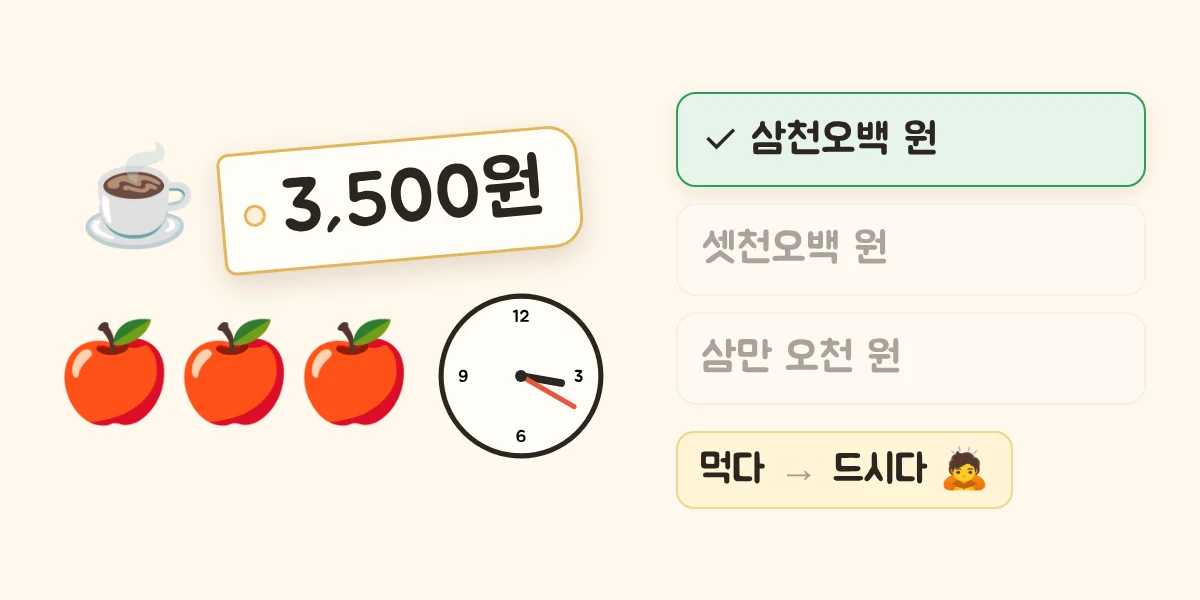 ▶ Korean Numbers & HonorificsTry Step 6 “Numbers & Honorifics” in Learn Korean: listen to prices, times and ages and pick the right answer.
FAQ
How do you count from 1 to 10 in Korean?
Sino-Korean: il, i, sam, sa, o, yuk, chil, pal, gu, sip. Native Korean: hana, dul, set, net, daseot, yeoseot, ilgop, yeodeol, ahop, yeol.
How do you tell the time in Korean?
Hours use native Korean numbers and minutes use Sino-Korean: 2:15 → du si sibo bun (두 시 십오 분).
How do you say your age in Korean?
Usually native Korean + sal: seumul-daseot sal (25). In formal writing, Sino-Korean + se: isibo se.
How do you say prices in Korean?
Sino-Korean + won: 15,000 won → man ocheon won, 3,500 won → samcheon obaek won.