Build Korean sentences from word blocks and pick the right particles
What this game trains you to do
Knowing the words is not the same as building a Korean sentence. The word order differs from English, and choosing between 이 and 가, or 을 and 를, trips up almost every learner. In this game you look at a picture and its meaning, then put word blocks in order, which drills the basic shape of a Korean sentence and the rule for picking particles. By the end of stage 5, the goal is to build short “who does what” sentences yourself and attach the right particle by checking the last letter of the word in front of it.
The verb goes last (stages 1–2)
In Korean the verb or adjective ends the sentence: 원숭이가 바나나를 먹어요 is literally “monkey banana eats”. Two- and three-block sentences get this order into your fingers.
Choose the particle by the final consonant (stage 3)
You fill a blank with 이/가, 을/를 or 은/는. After a final consonant (batchim) use 이, 을, 은; after a vowel use 가, 를, 는. You see words like 팔 and 닭 that end in a consonant next to words like 떡볶이 and 바나나 that end in a vowel.
Longer sentences (stage 4)
Sentences grow to 4–5 blocks with two trap blocks. They add place words like 문 옆에 (“next to the door”) and describing words like 뜨끈한 (“hot”) in front of a noun.
Particles as separate blocks (stage 5)
The noun and its particle come apart, for example 소방관 and 이. Attaching the particle yourself makes it clear that a particle is a separate piece added to the word, not part of it.
Learn what can move
바나나를 원숭이가 먹어요 is accepted as well as 원숭이가 바나나를 먹어요. The particles already mark who does what, so chunks ending in particles like 이/가, 을/를 or 에 can swap places as long as the verb stays at the end.
How to use
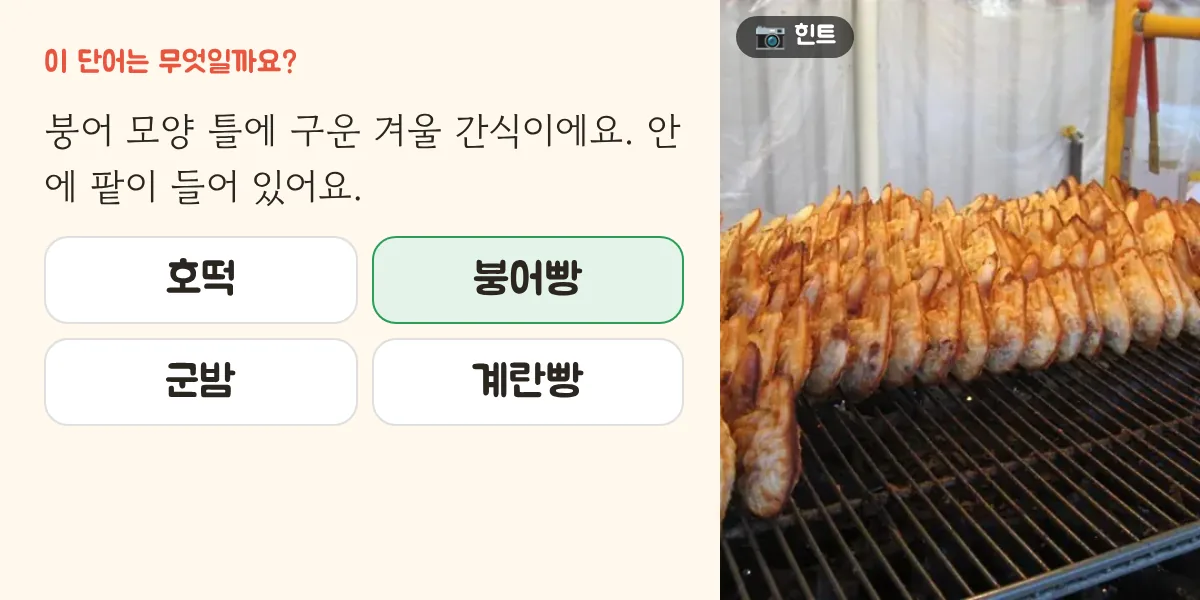
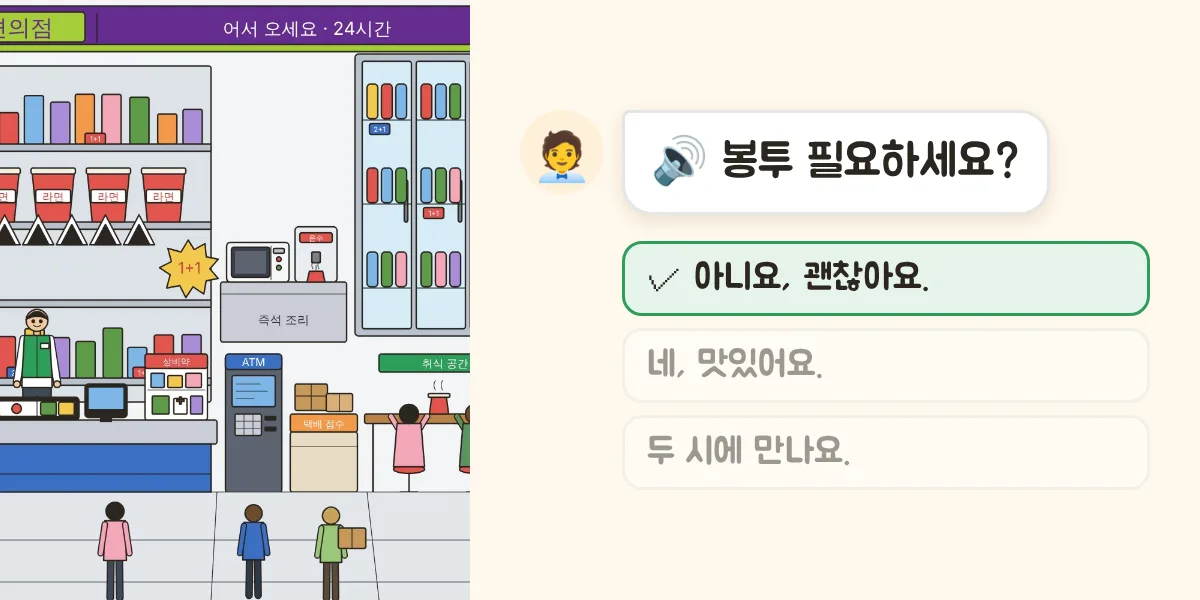
A big picture (a real photo when we have one) and the meaning appear in the middle, with word blocks mixed up below — including one or two traps, like a block with the wrong particle (그늘가 instead of 그늘이) or a block from another sentence. Tap only the right blocks in sentence order; once the sentence is complete it’s checked right away and read aloud. Tap a placed block to take it back.
Stages 1–2 use easy 2–3 block sentences. Stage 3 asks you to pick the right particle — 이/가, 을/를 or 은/는 (이·을·은 after a final consonant, 가·를·는 after a vowel). Stage 4 has 4–5 blocks, and Stage 5 splits the particle off into its own block. Swapping “who / what / where” chunks still counts if the meaning stays the same.
Each stage has 10 questions. Every mistake costs a heart; lose all 3 and the stage fails, so you start it again. You earn one star (up to 3) for each heart left, and any star unlocks the next stage. The sentences are the example sentences of the 732 words in Hangul Word Search, so you meet the words you learned there again — now inside sentences.
How to improve faster
Find the verb first
Look for the block ending in -요 or -다 and set it aside for the last slot. Then you only have to order what is left.
Filter traps by the final consonant
Blocks like 원숭이이 or 팔가 have a particle that doesn’t match the word. Before you tap a block, check whether the word ends in a consonant or a vowel.
Read the finished sentence aloud
Each finished sentence is read aloud. Say it back and you will also notice how a final consonant carries over into the particle: 팔이 sounds like [pari], 닭이 like [dalgi].
Stop and think after losing a heart
A mistake costs a heart and you try the same question again. Before retrying, work out whether the order or the particle was wrong.
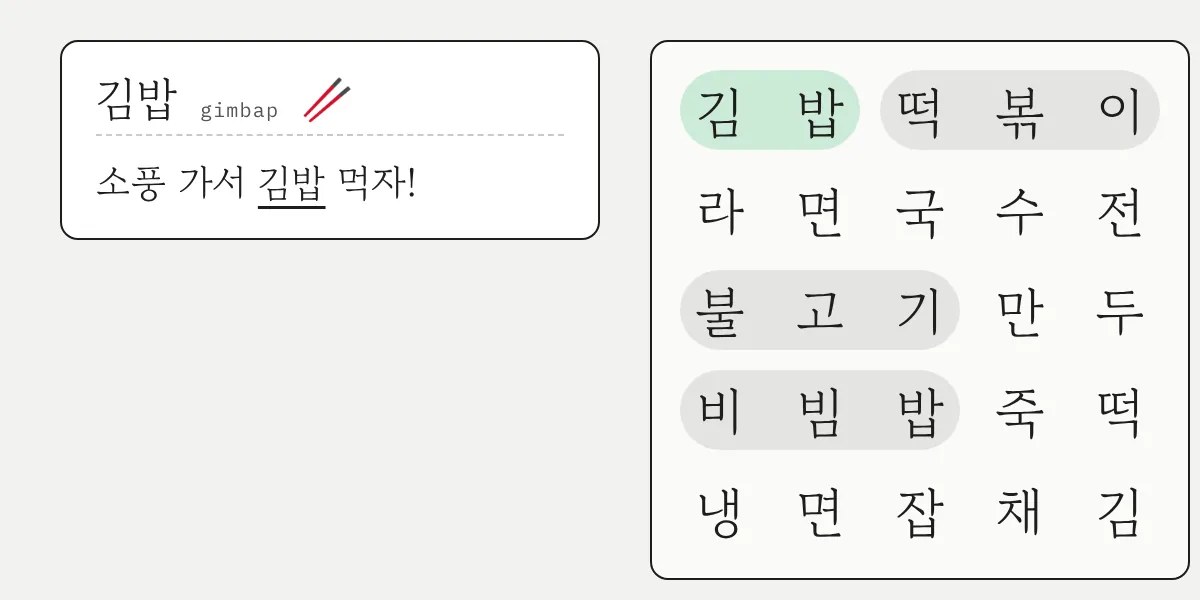
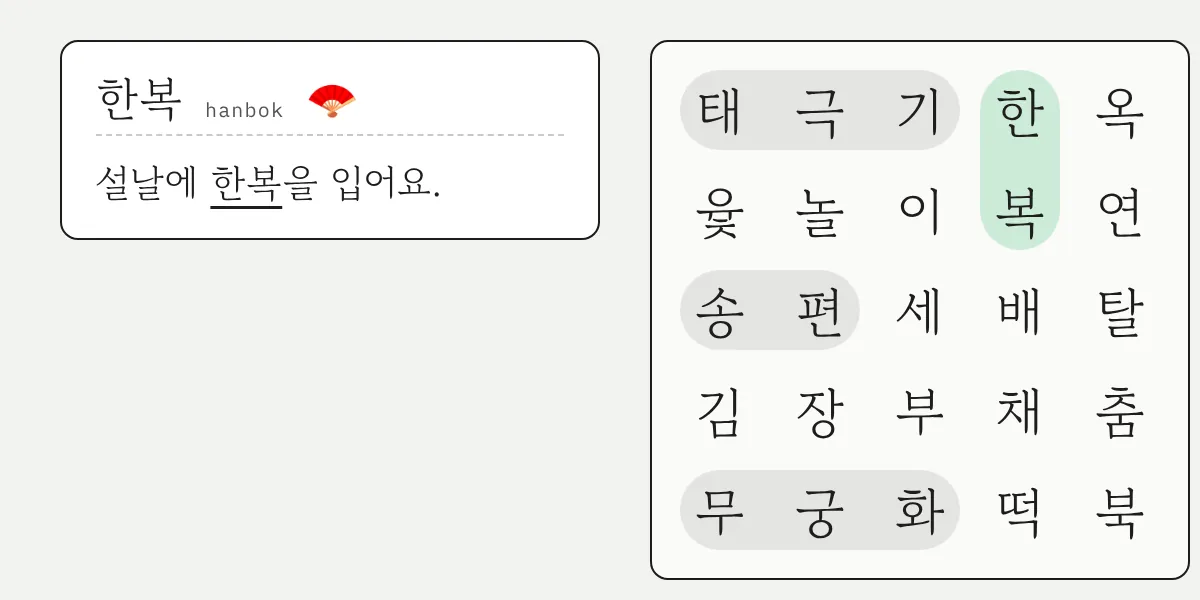
Pair it with Hangul Word Search
The sentences are the example sentences for the words in Hangul Word Search. Meeting a word there first and then inside a sentence here shows you how it is actually used.
Repeat stage 3
Particle questions are quick. Replay stage 3 until the consonant/vowel rule is automatic; stage 4’s longer sentences become much easier after that.
Sample questions
In the game you tap blocks to build the sentence. These questions use real sentences from the game. Where you would build a whole sentence, it is shown here as a choice between sentences to make it easier to read.
-
🧩 On screen: The monkey is eating a banana. Blocks: 먹어요. · 바나나를 · 원숭이이 · 원숭이가 (wonsungiga bananareul meogeoyo.)
Choices: 원숭이가 바나나를 먹어요. · 원숭이이 바나나를 먹어요. · 바나나를 먹어요. 원숭이가
✅ Answer: 원숭이가 바나나를 먹어요. — A stage 1 question. 원숭이 ends in a vowel, so it takes 가; 원숭이이 is the trap block. 바나나를 원숭이가 먹어요 is also accepted, but 먹어요 has to come last.
-
🧩 On screen: My arm hurts so much. 팔? 너무 아파요. (pari neomu apayo.)
Choices: 이 · 가
✅ Answer: 이 — 팔 ends in the consonant ㄹ, so it takes 이. The ㄹ moves over to the next syllable and 팔이 is pronounced [pari].
-
🧩 On screen: Tteokbokki is spicy and sweet. 떡볶이? 맵고 달아요. (tteokbokkineun maepgo darayo.)
Choices: 은 · 는
✅ Answer: 는 — The last syllable 이 has no final consonant. The ㅇ at the start of a syllable is silent and doesn’t count, so the word ends in a vowel and takes 는.
-
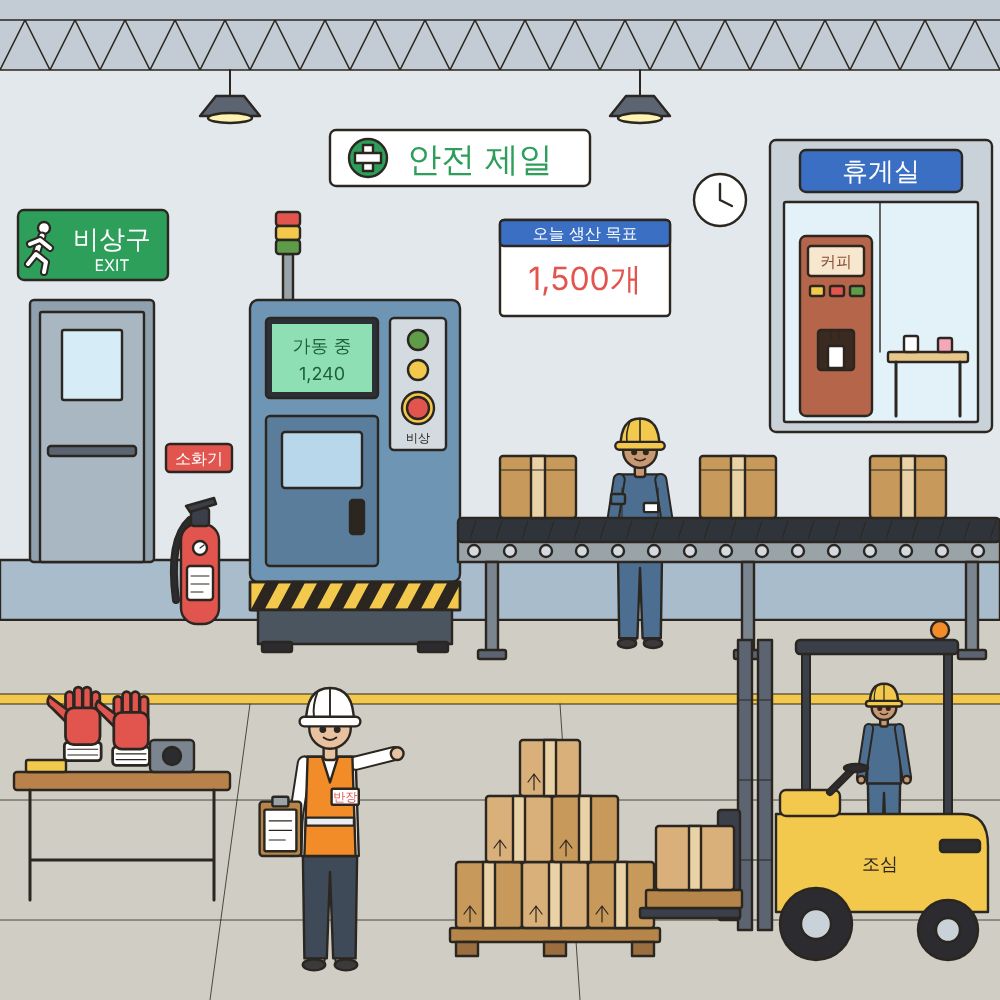
🧩 On screen: The fire extinguisher is next to the door. Blocks: 있어요. · 소화기는 · 소화기은 · 옆에 · 문 (+ one block from another sentence) (sohwagineun mun yeope isseoyo.)
Choices: 소화기는 문 옆에 있어요. · 소화기은 문 옆에 있어요. · 소화기는 옆에 문 있어요.
✅ Answer: 소화기는 문 옆에 있어요. — Stage 4 has two trap blocks. 소화기 ends in a vowel, so 는 is right. 문 옆에 means “at the door’s side”, so 문 has to come before 옆에, the reverse of English “next to the door”.
-
🧩 On screen: The firefighter puts out the fire. 소방관 [ ? ] 불을 꺼요. (sobanggwani bureul kkeoyo.)
Choices: 이 · 가
✅ Answer: 이 — In stage 5, 소방관 and 이 are separate blocks, with a trap 가 block next to them. 소방관 ends in ㄴ, so it takes 이.