Hangul Word Search: A Free Game for Learning Korean Words, One Syllable at a Time
Try to find 송편 (songpyeon) in the grid below. That’s the half-moon rice cake Koreans make for Chuseok, the autumn harvest festival. You’re looking for the syllable 송 (song) followed by 편 (pyeon). One hint: it isn’t across or down.
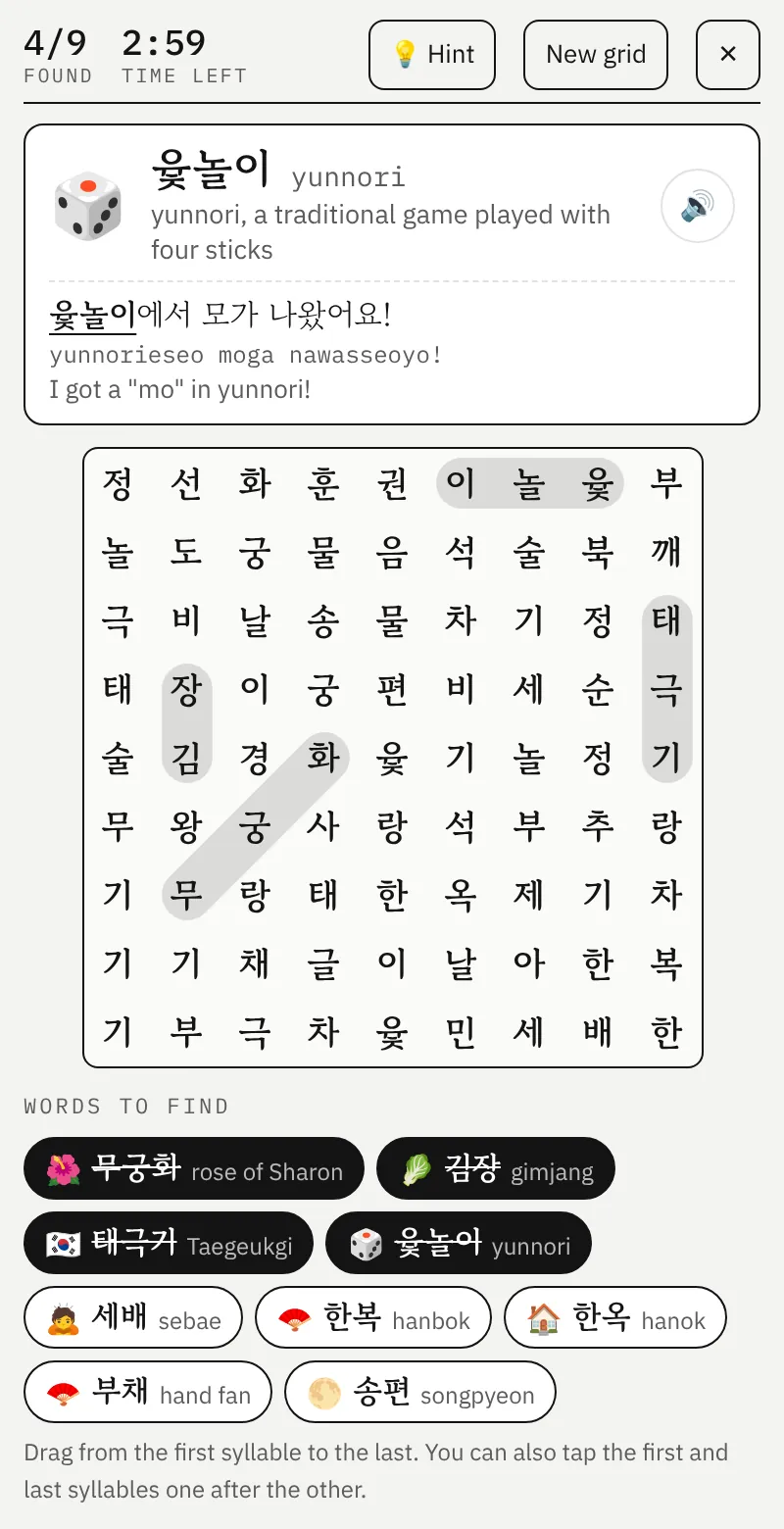
Found it? Look at the third row: 극 비 날 송 물 차 기 정 태. Start from 송, the fourth syllable, and step one square down and one to the right. There’s 편. The word runs diagonally down to the right.
The words already found are worth a second look too. 윷놀이 (yunnori) is spelled 윷·놀·이 (yut·nol·i), but in the top row it appears backwards, as 이·놀·윷 reading left to right. (Notice that it’s written yut-nol-i but pronounced yunnori: the final sound changes before ㄴ.) And 무궁화 (mugunghwa) climbs diagonally upward: 무 in the seventh row, 궁 up and to the right of it, then 화.
That’s what Vibe Lab’s Hangul Word Search is all about: finding Korean words hidden in a grid of Hangul.
Why I made this game
My son is learning Hangul right now, and this word search is something he really focuses on and does well.
I polished it and put it online hoping other kids learning Hangul, and anyone learning Korean, can enjoy learning it the same way.
A classic word search, in Hangul
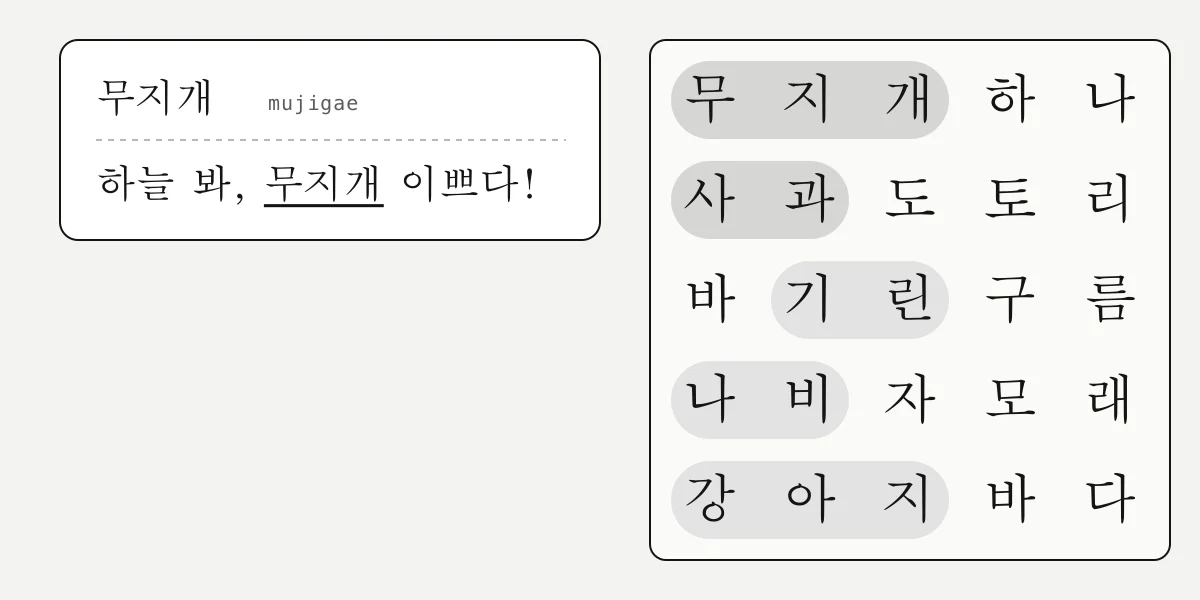
You’ve probably done a word search in a newspaper or puzzle book. This one works the same way, with one twist. In an English puzzle, each square holds a single letter. In Hangul Word Search, each square holds one Korean syllable block. As you trace 무, 지, 개 one after another, you get plenty of practice telling apart syllables with final consonants (batchim) and syllables that look almost the same.
The empty squares aren’t filled with random syllables. They’re filled with syllables from other words in the same theme. So you’ll see 무 all over the place, or find three 하 when you’re looking for 하늘 (haneul, sky). That’s where the fun of a word search comes from.
Find a word, and it’s read aloud with a picture and an example
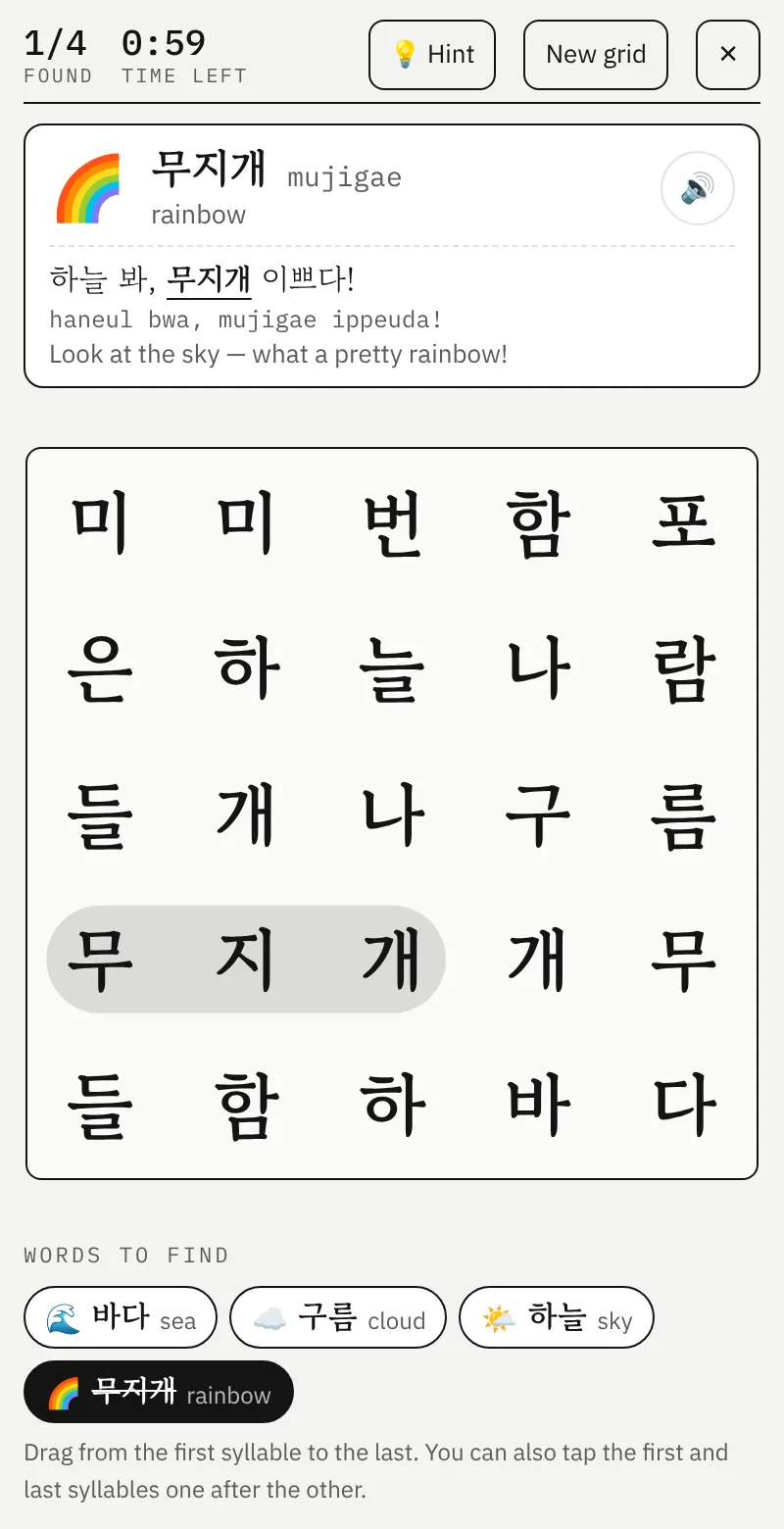
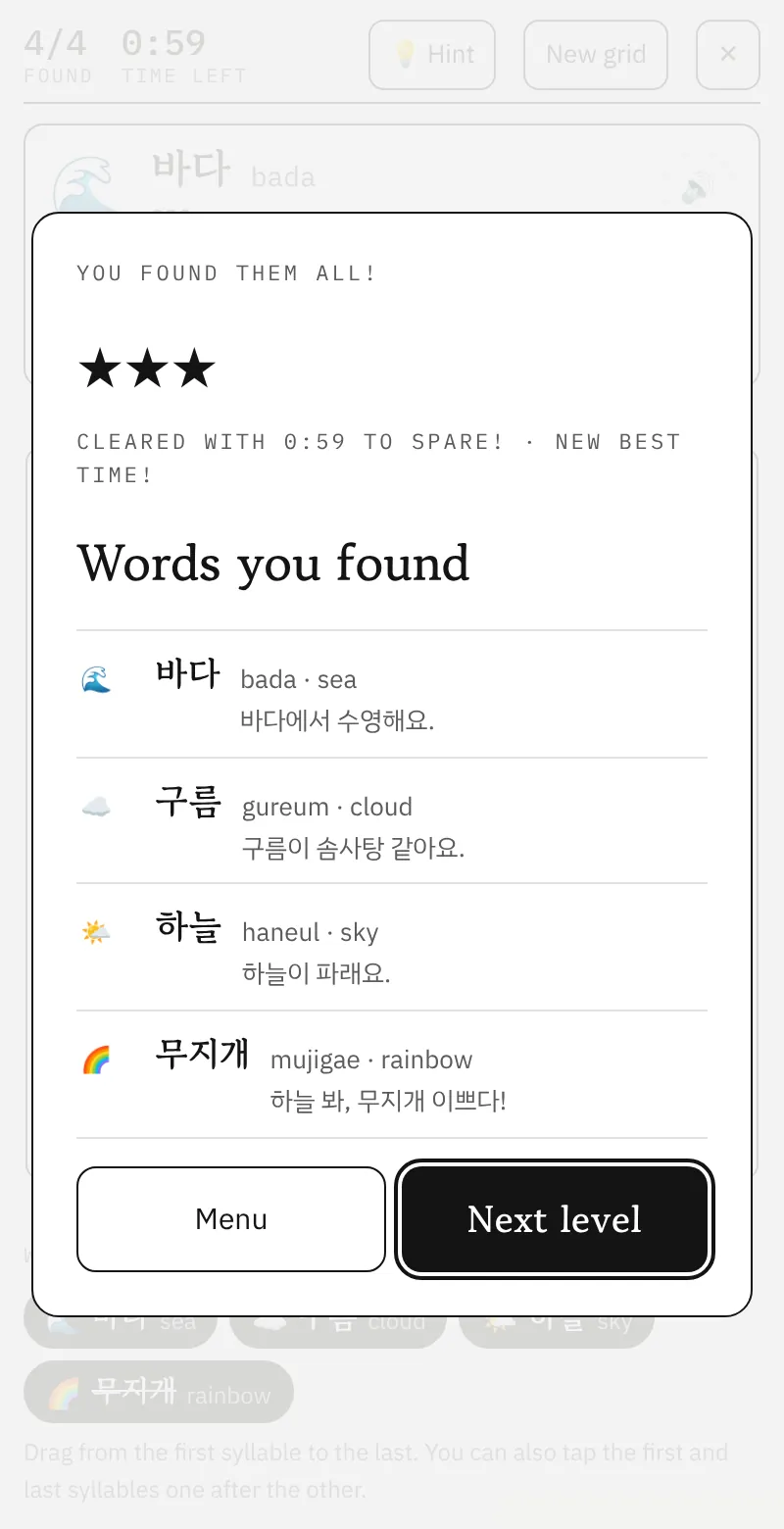
Drag your finger or mouse from the first syllable to the last, and the word gets circled. At the same time, the card at the top shows a picture, the romanization, the English meaning and a short example sentence using the word, and the game reads the word and the sentence aloud in Korean.
- 무지개 (mujigae): rainbow. “하늘 봐, 무지개 이쁘다!” (haneul bwa, mujigae ippeuda!) = Look at the sky — what a pretty rainbow!
- 윷놀이 (yunnori): a traditional game played with four sticks. “윷놀이에서 모가 나왔어요!” (yunnorieseo moga nawasseoyo!) = I got a “mo” in yunnori!
- 송편 (songpyeon): half-moon rice cakes for Chuseok. “추석에 송편을 빚어요.” (chuseoge songpyeoneul bijeoyo.) = We make songpyeon for Chuseok.
If dragging is tricky, for example for young children, you can also tap the first syllable and then the last. On a computer, you can move around the grid with the arrow keys and select with Enter.
Sometimes a word that isn’t on the list happens to appear in the grid. Spot one and the game tells you it’s a Bonus, so keep your eyes open.
10 themes, 5 levels
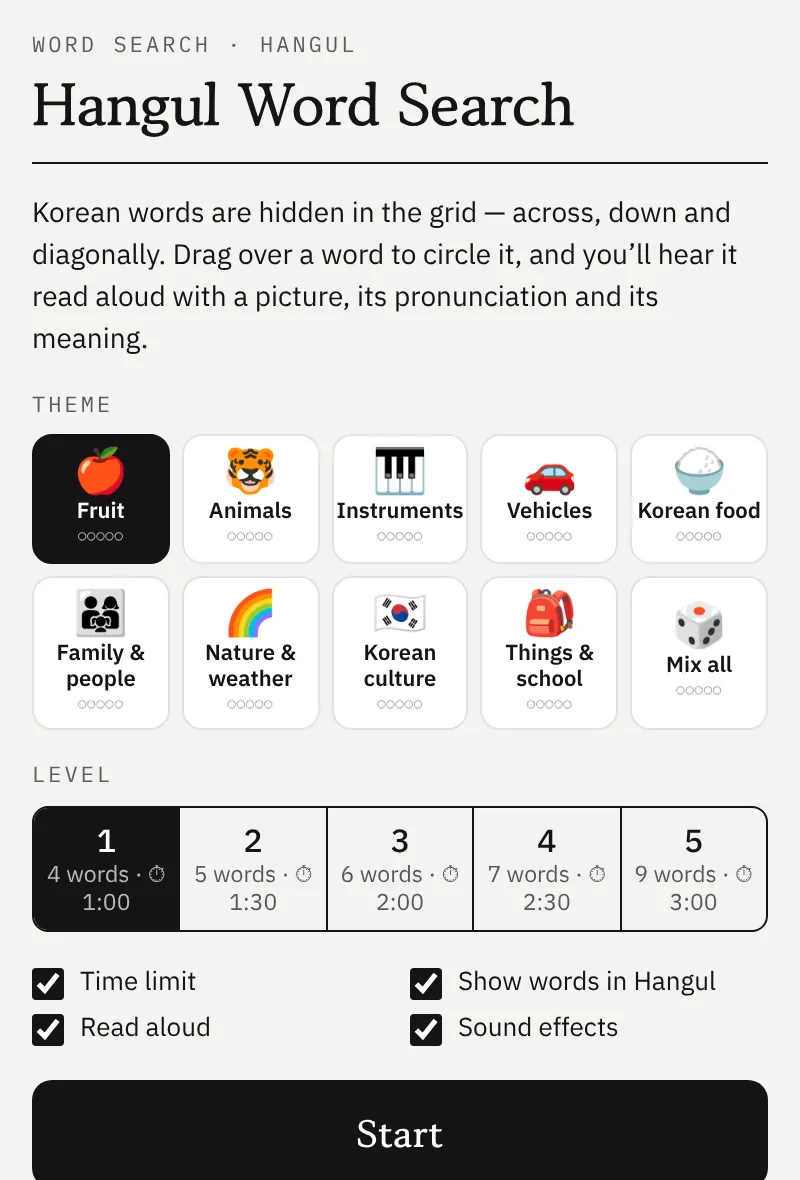
There are 10 themes: Fruit, Animals, Instruments, Vehicles, Korean food, Family & people, Nature & weather, Korean culture, Things & school, and Museum & history, plus Mix all to play them all together. The 252 words range from easy ones like 사과 (sagwa, apple) and 나비 (nabi, butterfly) to words full of Korean culture like 한복 (hanbok, traditional Korean clothes), 송편 (songpyeon) and 세종대왕 (Sejong Daewang, King Sejong the Great, who created Hangul). Within a theme, the game picks words you haven’t seen yet first, so you won’t keep getting the same ones.
| Level | Grid | Directions | Words | Time limit |
|---|---|---|---|---|
| 1 | 5×5 | → across | 4 | 1:00 |
| 2 | 6×6 | → ↓ across and down | 5 | 1:30 |
| 3 | 7×7 | → ↓ across and down | 6 | 2:00 |
| 4 | 8×8 | → ↓ ↘ plus diagonal | 7 | 2:30 |
| 5 | 9×9 | ↔ ↕ ↘ ↗ even backwards | 9 | 3:00 |
At Level 1, every word reads left to right, so even someone who has just learned to read Hangul can play. As the levels go up, the grid gets bigger and the words move from easy to harder ones. Clear a level to move on to the next, and each theme marks the levels you’ve cleared with a ●.
Time limit, stars and hints
Each level has a time limit, and you need to find every word in time to move on to the next level. Finish with more than half the time left for three stars, or more than a quarter left for two. If you’d rather not race the clock, turn off Time limit on the home screen and take it easy. Your time is then recorded instead.
Really stuck? Tap 💡 Hint and the first syllable of a word you haven’t found yet will flash. Just keep in mind that when the time limit is on, each hint costs you 5 seconds.
Learning Korean? Turn off “Show words in Hangul”
Turn off “Show words in Hangul” on the home screen, and the list of words to find shows only pictures and meanings instead of Hangul. You see 🌈 rainbow, recall 무지개 (mujigae), and then hunt for it in the grid. It turns the game into a quiz that checks whether you really remember the words.
The game also has Korean, Japanese, Chinese (Traditional and Simplified), Malay, Spanish, Vietnamese, Thai and Indonesian screens. On this English screen, every word comes with its romanization, its English meaning and a translation of the example sentence, so you can say the words along with the audio even before you can read Hangul.
Who it’s for
- Korean learners: following one syllable at a time trains your eyes to recognize Hangul shapes, and the example sentences show you how each word is actually used.
- Kids just starting to read Hangul, and their parents: at Level 1, every word runs across, and each find is rewarded with a picture and sound.
- Anyone who wants a quick brain workout: the 9×9 grid at Level 5 has diagonal and backwards words to find in 3 minutes, and it’s more nerve-racking than you’d think.
No download, no sign-up. Open Hangul Word Search and start by finding 무지개! And if you’d like to learn Korean words by spotting objects in pictures, try Korea Hidden Pictures too.